[ . BACK to DARUMA MUSEUM TOP . ]
. Japan - Shrines and Temples - Index .
. Buddhist Temples and their Legends .
. Ise Saigoku 33 Kannon 伊勢西国三十三所観音巡礼 Pilgrimage .
::::::::::::::::::::::::::::::::::::::::::::::::::::::::::::::::::::::::::::::::::::::::::::::::::::::::::::::::::::::::::::::::::::::::::::::::::::::::::::::::::::::::::::::
Tamiyaji 田宮寺 Tamiya-Ji, Tamaki
富向山 Fukozan 田宮寺 Tamiyaji
度会郡玉城町田宮寺322 / Mie, Watari district, Tamaki town, Tamiyaji
One Kannon statue is Juichimen Kannon .
The temple has two Kannon Statues.
- quote -
Book : 勢陽五鈴遺響 Seiyō Gorei Ikyō
たみやでら神も仏もひとつなれ わきておがまぬかたちだになし
拾遺云大神宮ノ御船ヲ納ル処ナリ
Tamiya-ji temple, where Shinto Gods and Buddhist Gods become one, you don’t pray to each separately because from the beginning they don’t have any form.
According to the records it is a place where Mifune vessel from Ise Shrine is stored.
According to temple’s legend, it was founded by 行基菩薩 Gyōki (668-749), a famous monk who traveled around Japan to preach to commoners, in September 725.
. 行基菩薩 Gyoki Bosatsu (668 - 749) .
As ordered by Emperor Shōmu (701-756), he named the temple Jingū Hōraku-ji and as a main statue he made two statues of Eleven-faced Kannon. Between 767 and 770 the temple’s buildings were lost in the fire. They were rebuilt thanks to Kūkai (Kōbō Daishi, 774-835, the founder of Shingon sect), who stayed at the grounds for some time after his return from China. Later when Tamiya-ji prospered again, Kūkai was acknowledged and worshiped as a rebuilder of the temple.
According to commentary written by Ōnishi Gen’ichi and included in the official temple’s pamphlet issued by supporter group, Tamiya-ji was built between 995 and 999 by a head of Arakida clan, who was also a head priest at the Ise Shrine. Since then the temple became Arakida’s family temple and abbots were also chosen from members of that clan (and Shingon sect monks at the same time). Because the records from 1496 state that the temple was rebuilt once again that year, it probably fall into a decline at some point.
In Nara (710-794) and Heian (794-1192) period, when Buddhism prospered in Japan, Buddhist temples (Jingū-ji) were built within main Shinto shrine’s grounds. For example a Jingū-ji temple connected to Ise Shrine was placed in Ōkase in Taki-chō district. Tamiya-ji was also constructed as a Hōraku-ji temple – a temple bringing Buddhist teachings and Enlightenment to Shinto gods of Ise Shrine. At its grounds there was a hall called Mifune Hall which would store a box called Mifuneshiro (vessel to transport the divine artefact, originally in a shape of a boat) used during the Shikinen Sengū ritual (rebuilding of the shrine) at the Ise Shrine. The new Mifuneshiro would be presented to Tamiya-ji each twenty years, after it has been used for the ceremony.
Regional powerful clans of Kitabatake, Tamaru and Aisu donated lands of Tamiya-ji village, Katsuta, Yano and Hara village to the temple. According to the land survey conducted in 16th Century, among the temple’s land an equivalent of 5.95 ha (14.7 ac) was the donated land. During 17th and 18th Century this land produced 2t of rice every year.
Beside the Main Hall, more buildings such as Daishi Hall (Hall of Kūkai), Tenjin shrine (Shinto God of Knowledge and Thunders = Sugawara no Michizane), Mifune Hall (Hall with the divine vessel), Shōten Hall (Kangiten, Ganesha, a god of conjugal harmony and long life), Fudō Hall (Hall of Fudō Myō-ō – Immovable Wisdom King), Dainichi Hall (Great Illuminating Buddha) and buildings of a sub-temple (tacchū) Higashinobō Kōgi-in used to stand. But after the order of Separation of Shinto and Buddhism (shinbutsu bunri) was issued by Meiji government in 1869,
Tamiya-ji seized to exist. All buildings except for Shōten Hall and living quarters of the abbot were torn down.
Main statues of Tamiya-ji are two 167cm high statues of Jūichimen Kannon (Eleven-Faced Kannon) made in the 9th Century (beginning of Heian period). Each is made from single block of Japanese hinoki cypress. One of the statues has some coloring left, while on the other some gold foil can still be found.
These two Kannon statues were first registered as National Treasure in 1915, to be registered also as Important Cultural Properties in 1950. Both of them are enshrined in the Shōten Hall of the Tamiya-ji temple.
On the 18th of every month a temple’s festival is held. Many visitors from close and far come to pray and whish for: expelling of bad luck, finding love, happy marriage, family members’ luck, fortune in business, safety of the household, abundant crops, protection from disasters, good fortune, pregnancy and safe childbirth. Two Kannon statues are shown to the public during special ceremonies on the 18th of February and 9th of August.
- source : isekannon.jp ..
..............................................................................................................................................
shuin 朱印 stamp
.......................................................................
- Yearly Festivals 年中行事 -
On the 18th of every month a temple’s festival is held.
Many visitors from close and far come to pray and whish for: expelling of bad luck, finding love, happy marriage, family members’ luck, fortune in business, safety of the household, abundant crops, protection from disasters, good fortune, pregnancy and safe childbirth.
Two Kannon statues are shown to the public during special ceremonies on the 18th of February and 9th of August.
- reference : otera_list_en/tamiyaji ... -
.......................................................................
- - - - - Homepage of the temple
- source : otera_list/tamiyaji ...
- reference source : nippon-reijo.jimdofree ... -
::::::::::::::::::::::::::::::::::::::::::::::::::::::::::::::::::::::::::::::::::::::::::::::::::::::::::::::::::::::::::::::::::::::::::::::::::::::::::::::::::::::::::::::
This temple is Nr. 04 of the pilgrimage
. Ise Saigoku 33 Kannon 伊勢西国三十三所観音巡礼 Pilgrimage .
. Kannon Bosatsu 観音菩薩 Avalokiteshvara .
. Juichimen Kannon 十一面観音 Senju Kannon 千手観音 Kannon with 11 faces and 1000 arms .
::::::::::::::::::::::::::::::::::::::::::::::::::::::::::::::::::::::::::::::::::::::::::::::::::::::::::::::::::::::::::::::::::::::::::::::::::::::::::::::::::::::::::::::
. Temples with legends .
. Japanese Legends - 伝説 民話 昔話 – ABC-List .
. Japan - Shrines and Temples - Index .
[ . BACK to DARUMA MUSEUM . TOP . ]
[ . BACK to WORLDKIGO . TOP . ]
- - #Tamiyaji #isesaigoku #isesaikoku ##isekannon #tamaki -
::::::::::::::::::::::::::::::::::::::::::::::::::::::::::::::::::::::::::::::::::::::::::::::::::::::::::::::::::::::::::::::::::::::::::::::::::::::::::::::::::::::::::::::
2022/09/05
2022/09/04
Fudo Hall Omagi
[ . BACK to DARUMA MUSEUM TOP . ]
. Japan - Shrines and Temples - Index .
. Buddhist Temples and their Legends .
. Adachi 100 Fudo Temples 足立百不動尊霊場 Pilgrimage .
::::::::::::::::::::::::::::::::::::::::::::::::::::::::::::::::::::::::::::::::::::::::::::::::::::::::::::::::::::::::::::::::::::::::::::::::::::::::::::::::::::::::::::::
Fudo-Do 不動堂 Fudo Hall - Omagi
八丁観音堂内 in the compound of Hatcho Kannon Do
Hatcho Fudo-Do 八丁不動堂 Hatcho Fudo Hall - 玉泉院 Gyokusen-In
さいたま市緑区大間木1906 / Saitama, Midori ward, Omagi
The Fudo Myo-O statue is seated, with two acolytes at the side.
Nearby is
大間木稲荷神社 the Inari Shrine of Omagi, which was founded in 1731,
so the Fudo Hall might have been constructed at the same time.
- source : tesshow ...
..............................................................................................................................................
Also on the following pilgrimage:
. 足立坂東三十三ヶ所霊場 Adachi Bando 33 Kannon Temples . - Nr. 17 - Bangai
.......................................................................
- - - - - Reference of the Temple
- reference source : tesshow -
- reference source : hanaetabi.fc2web.com/hudou/index ... -
- reference source : nippon-reijo.jimdofree ... -
::::::::::::::::::::::::::::::::::::::::::::::::::::::::::::::::::::::::::::::::::::::::::::::::::::::::::::::::::::::::::::::::::::::::::::::::::::::::::::::::::::::::::::::
This Temple is Nr. 20 of the
. Adachi 100 Fudo Temples 足立百不動尊霊場 Pilgrimage .
::::::::::::::::::::::::::::::::::::::::::::::::::::::::::::::::::::::::::::::::::::::::::::::::::::::::::::::::::::::::::::::::::::::::::::::::::::::::::::::::::::::::::::::
. Temples with legends .
. Kita Adachi 88 Fudo Temples 北足立八十八ヵ所霊場 .
. Japanese Legends - 伝説 民話 昔話 – ABC-List .
. Japan - Shrines and Temples - Index .
[ . BACK to DARUMA MUSEUM . TOP . ]
[ . BACK to WORLDKIGO . TOP . ]
- - #hatchokannondo #hatchofudo #Fudoomagi #omagifudo #fudohall #adachifudo #busoo #busou -
::::::::::::::::::::::::::::::::::::::::::::::::::::::::::::::::::::::::::::::::::::::::::::::::::::::::::::::::::::::::::::::::::::::::::::::::::::::::::::::::::::::::::::::
. Japan - Shrines and Temples - Index .
. Buddhist Temples and their Legends .
. Adachi 100 Fudo Temples 足立百不動尊霊場 Pilgrimage .
::::::::::::::::::::::::::::::::::::::::::::::::::::::::::::::::::::::::::::::::::::::::::::::::::::::::::::::::::::::::::::::::::::::::::::::::::::::::::::::::::::::::::::::
Fudo-Do 不動堂 Fudo Hall - Omagi
八丁観音堂内 in the compound of Hatcho Kannon Do
Hatcho Fudo-Do 八丁不動堂 Hatcho Fudo Hall - 玉泉院 Gyokusen-In
さいたま市緑区大間木1906 / Saitama, Midori ward, Omagi
The Fudo Myo-O statue is seated, with two acolytes at the side.
Nearby is
大間木稲荷神社 the Inari Shrine of Omagi, which was founded in 1731,
so the Fudo Hall might have been constructed at the same time.
- source : tesshow ...
..............................................................................................................................................
Also on the following pilgrimage:
. 足立坂東三十三ヶ所霊場 Adachi Bando 33 Kannon Temples . - Nr. 17 - Bangai
.......................................................................
- - - - - Reference of the Temple
- reference source : tesshow -
- reference source : hanaetabi.fc2web.com/hudou/index ... -
- reference source : nippon-reijo.jimdofree ... -
::::::::::::::::::::::::::::::::::::::::::::::::::::::::::::::::::::::::::::::::::::::::::::::::::::::::::::::::::::::::::::::::::::::::::::::::::::::::::::::::::::::::::::::
This Temple is Nr. 20 of the
. Adachi 100 Fudo Temples 足立百不動尊霊場 Pilgrimage .
::::::::::::::::::::::::::::::::::::::::::::::::::::::::::::::::::::::::::::::::::::::::::::::::::::::::::::::::::::::::::::::::::::::::::::::::::::::::::::::::::::::::::::::
. Temples with legends .
. Kita Adachi 88 Fudo Temples 北足立八十八ヵ所霊場 .
. Japanese Legends - 伝説 民話 昔話 – ABC-List .
. Japan - Shrines and Temples - Index .
[ . BACK to DARUMA MUSEUM . TOP . ]
[ . BACK to WORLDKIGO . TOP . ]
- - #hatchokannondo #hatchofudo #Fudoomagi #omagifudo #fudohall #adachifudo #busoo #busou -
::::::::::::::::::::::::::::::::::::::::::::::::::::::::::::::::::::::::::::::::::::::::::::::::::::::::::::::::::::::::::::::::::::::::::::::::::::::::::::::::::::::::::::::
2022/09/03
Kofukuji Yakushi Hiraiwa
[ . BACK to DARUMA MUSEUM TOP . ]
. Japan - Shrines and Temples - Index .
. Buddhist Temples and their Legends .
. 49 Yakushi Temples in Kyushu 九州四十九薬師霊場 .
::::::::::::::::::::::::::::::::::::::::::::::::::::::::::::::::::::::::::::::::::::::::::::::::::::::::::::::::::::::::::::::::::::::::::::::::::::::::::::::::::::::::::::::
Koofukuji 幸福寺 Kofuku-Ji, Hiraiwa
寶来山 Horaizan 幸福寺 Kofukuji
宮崎県日向市平岩9983 / Miyazaki, Hyuga city, Hiraiwa
The Yakushi statue is 幸福薬師 Kofuku Yakushi - Yakushi to bring happiness.
The main statue is 釈迦牟尼仏 Shakamuni Buddha.
The temple was founded in 1595 by the local lord 松葉源之亟景守 Matsubara Gennojo,
who later became a priest called 棟岩謹呈和尚.
In times of epidemics and famine, he held special rituals and helped the people.
People come to this temple to pray for good health and safety for the family.
In the compound is 観音堂 a Kannon Hall with a statue of
Senju Kannon (Koyasu Kannon) 千手観音 (子安観音) Kannon with 1000 arms to help bring up children.
..............................................................................................................................................
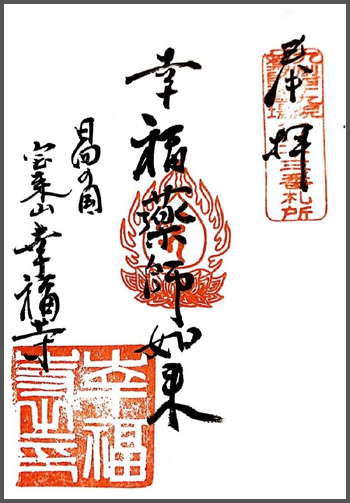
shuin 朱印 stamp
.......................................................................
- Yearly Festivals 年中行事 -
A long list :
- reference : miyazaki/jiin ..-
.......................................................................
- - - - - Reference of the temple
- source : miyazaki-koufukuzi ...
- source : oyakushi.com ...
- reference source : nippon-reijo.jimdofree ... -
::::::::::::::::::::::::::::::::::::::::::::::::::::::::::::::::::::::::::::::::::::::::::::::::::::::::::::::::::::::::::::::::::::::::::::::::::::::::::::::::::::::::::::::
This temple is Nr. 23 of the pilgrimage
. 49 Yakushi Temples in Kyushu 九州四十九薬師霊場 .
. 薬師如来 Yakushi Nyorai Bhaisajyaguru .
the Buddha of Medicine and Healing
::::::::::::::::::::::::::::::::::::::::::::::::::::::::::::::::::::::::::::::::::::::::::::::::::::::::::::::::::::::::::::::::::::::::::::::::::::::::::::::::::::::::::::::
. Japanese Legends - 伝説 民話 昔話 – ABC-List .
....................................................................... Saitama 埼玉県
菖蒲町 Shobu town
taikozaka 太鼓坂 the slope of the big drum
Once upon a time, near 幸福寺 the Temple Kofuku-Ji there lived ryuu 竜 one dragon.
He was the master of kanetsukidoo 鐘つき堂 the Temple Bell Hall.
One day the dragon went to the local pond and when he came back, he found that someone had stolen the bell.
The dragon became quite crazy about the loss, took the big drum and run away, shouting
"I am going to borrow this, when the bell comes back, I bring it back!"
After that, nobody had seen the drum any more.
If people walk along the slope of the temple, they can hear the sound of
"ponpon, ponpon" - the big drum.
Anyway, the bell was stolen by the dragon from 筑波山 Mount Tsukubasan.
If the bell rings at Tsukuba Temple, people can hear it sing:
kayama koishi 栢間恋し I long for Kayama.
- - another legend from the temple
One evening a beautifully dressed 弁天様 Benten Sama came here and stepped on the ground.
There was the sound of a drum. Benten liked the sound, begun to play her Biwa and danced.
When morning came, she disappeared.
Now people called the place "slope of the big drum".
- reference : 菖蒲町の坂 -
. ryuu, ryū 龍 竜 伝説 Ryu - dragon legends .
..............................................................................................................................................
- reference : Nichibun Yokai Database -
::::::::::::::::::::::::::::::::::::::::::::::::::::::::::::::::::::::::::::::::::::::::::::::::::::::::::::::::::::::::::::::::::::::::::::::::::::::::::::::::::::::::::::::
. Temples with legends .
. Japanese Legends - 伝説 民話 昔話 – ABC-List .
. Japan - Shrines and Temples - Index .
[ . BACK to DARUMA MUSEUM . TOP . ]
[ . BACK to WORLDKIGO . TOP . ]
- - #kofukuji #kofukuzi #tsukubasan #yakushikyushu #yakushipilgrims #薬師如来 -
::::::::::::::::::::::::::::::::::::::::::::::::::::::::::::::::::::::::::::::::::::::::::::::::::::::::::::::::::::::::::::::::::::::::::::::::::::::::::::::::::::::::::::::
. Japan - Shrines and Temples - Index .
. Buddhist Temples and their Legends .
. 49 Yakushi Temples in Kyushu 九州四十九薬師霊場 .
::::::::::::::::::::::::::::::::::::::::::::::::::::::::::::::::::::::::::::::::::::::::::::::::::::::::::::::::::::::::::::::::::::::::::::::::::::::::::::::::::::::::::::::
Koofukuji 幸福寺 Kofuku-Ji, Hiraiwa
寶来山 Horaizan 幸福寺 Kofukuji
宮崎県日向市平岩9983 / Miyazaki, Hyuga city, Hiraiwa
The Yakushi statue is 幸福薬師 Kofuku Yakushi - Yakushi to bring happiness.
The main statue is 釈迦牟尼仏 Shakamuni Buddha.
The temple was founded in 1595 by the local lord 松葉源之亟景守 Matsubara Gennojo,
who later became a priest called 棟岩謹呈和尚.
In times of epidemics and famine, he held special rituals and helped the people.
People come to this temple to pray for good health and safety for the family.
In the compound is 観音堂 a Kannon Hall with a statue of
Senju Kannon (Koyasu Kannon) 千手観音 (子安観音) Kannon with 1000 arms to help bring up children.
..............................................................................................................................................
shuin 朱印 stamp
.......................................................................
- Yearly Festivals 年中行事 -
A long list :
- reference : miyazaki/jiin ..-
.......................................................................
- - - - - Reference of the temple
- source : miyazaki-koufukuzi ...
- source : oyakushi.com ...
- reference source : nippon-reijo.jimdofree ... -
::::::::::::::::::::::::::::::::::::::::::::::::::::::::::::::::::::::::::::::::::::::::::::::::::::::::::::::::::::::::::::::::::::::::::::::::::::::::::::::::::::::::::::::
This temple is Nr. 23 of the pilgrimage
. 49 Yakushi Temples in Kyushu 九州四十九薬師霊場 .
. 薬師如来 Yakushi Nyorai Bhaisajyaguru .
the Buddha of Medicine and Healing
::::::::::::::::::::::::::::::::::::::::::::::::::::::::::::::::::::::::::::::::::::::::::::::::::::::::::::::::::::::::::::::::::::::::::::::::::::::::::::::::::::::::::::::
. Japanese Legends - 伝説 民話 昔話 – ABC-List .
....................................................................... Saitama 埼玉県
菖蒲町 Shobu town
taikozaka 太鼓坂 the slope of the big drum
Once upon a time, near 幸福寺 the Temple Kofuku-Ji there lived ryuu 竜 one dragon.
He was the master of kanetsukidoo 鐘つき堂 the Temple Bell Hall.
One day the dragon went to the local pond and when he came back, he found that someone had stolen the bell.
The dragon became quite crazy about the loss, took the big drum and run away, shouting
"I am going to borrow this, when the bell comes back, I bring it back!"
After that, nobody had seen the drum any more.
If people walk along the slope of the temple, they can hear the sound of
"ponpon, ponpon" - the big drum.
Anyway, the bell was stolen by the dragon from 筑波山 Mount Tsukubasan.
If the bell rings at Tsukuba Temple, people can hear it sing:
kayama koishi 栢間恋し I long for Kayama.
- - another legend from the temple
One evening a beautifully dressed 弁天様 Benten Sama came here and stepped on the ground.
There was the sound of a drum. Benten liked the sound, begun to play her Biwa and danced.
When morning came, she disappeared.
Now people called the place "slope of the big drum".
- reference : 菖蒲町の坂 -
. ryuu, ryū 龍 竜 伝説 Ryu - dragon legends .
..............................................................................................................................................
- reference : Nichibun Yokai Database -
::::::::::::::::::::::::::::::::::::::::::::::::::::::::::::::::::::::::::::::::::::::::::::::::::::::::::::::::::::::::::::::::::::::::::::::::::::::::::::::::::::::::::::::
. Temples with legends .
. Japanese Legends - 伝説 民話 昔話 – ABC-List .
. Japan - Shrines and Temples - Index .
[ . BACK to DARUMA MUSEUM . TOP . ]
[ . BACK to WORLDKIGO . TOP . ]
- - #kofukuji #kofukuzi #tsukubasan #yakushikyushu #yakushipilgrims #薬師如来 -
::::::::::::::::::::::::::::::::::::::::::::::::::::::::::::::::::::::::::::::::::::::::::::::::::::::::::::::::::::::::::::::::::::::::::::::::::::::::::::::::::::::::::::::
2022/09/02
Matsuo Kannonji Kusube
[ . BACK to DARUMA MUSEUM TOP . ]
. Japan - Shrines and Temples - Index .
. Kannon-Ji 観音寺 Temple Legends .
. Ise Saigoku 33 Kannon 伊勢西国三十三所観音巡礼 Pilgrimage .
::::::::::::::::::::::::::::::::::::::::::::::::::::::::::::::::::::::::::::::::::::::::::::::::::::::::::::::::::::::::::::::::::::::::::::::::::::::::::::::::::::::::::::::
Matsuo Kannonji 松尾観音寺 Matsuo Kannon-Ji, Kusube
龍池山 Ryūchizan 松尾観音寺 Matsuo Kannonji
伊勢市楠部町 松尾山 156-6 / Ise City, Kusube town, Matsuosan
The Kannon statue is 十一面 Juichimen Kannon.
- quote
According to temple’s records, Matsuo Kannon-ji was built in Nara period (712) by Gyōki – a high priest who came to Mount Matsuo during his pilgrimage to Ise Shrine. This temple does not have branches (matsuji) or associated believers (danka), also it does not belong to any Buddhist sect. Matsuo Kannon-ji is a temple specialized in prayer for divine favors.
Its main statue is a miraculous Jūichimen Kannon (Eleven-Faced Kannon), accompanied by
Bodhisattva Jizō (Bodhisattva who looks over children, travelers and the underworld) and
Bishamon (God of Treasure, Wealth, & Warriors). Many visitors come and pray to them asking for warding off calamities, bringing good fortune and many other favors.
For generations Matsu Kannon-ji was protected by the Kitabatake clan, a family of Governors of Ise. After Kitabatake clan was united and changed their surname to Kotsukuri, the temple became their official family temple (ujidera).
The Main Hall of the temple is made from Japanese zelkova. It was donated by Kotsukuri Nagasato and constructed 200 years ago in 1820.
In 1998 Kannon Hall was rebuilt thanks to donations gathered from all over the country in a fund-raising campaign organized by local supporters.
- - - 10.000 sutra copies in a finial of the roof
During the construction works at the roof of the Main Hall in 1954, 10.000 copies of Lotus Sutra were found inside the finial of the roof. All of them were written by hand and put in 500 boxes. To protect the sutras from bookworms, they were wrapped in oiled paper and sealed in boxes together with tobacco leaves.
- - - The legend of pond dragons that protect the main statue
There is a legend which explains the Mountain name of this temple – Ryūchizan (Dragon pond mountain).
The name comes from two ponds behind the Main Hall which are called
Futatsu ike (Two Ponds) or Ryū ike (Dragon Ponds).
People believe that since ancient times there are two dragons living in them, a male dragon in the eastern pond and a female dragon in the western. Their role is to protect Goddess Kannon enshrined in this temple. According to a legend, 600 years ago in 1403, when the Main Hall was on fire, two dragons protected the Goddess from burning. The male dragon flew down from the sky and while sucking in the flames, he wrapped the statue with his own body. Then the female dragon took water from the pond in her mouth and sprayed on the fire protecting them both from burning.
Since then in the end of every month, monks offer sake, eggs and rice in front of both of the ponds. This is to show their gratitude to the dragons for saving Goddess Kannon on that day.
Because of that legend people started to believe this Kannon has power to protect people from disasters.
Also because dragons appearing in the story are male and female, people also believe that the Goddess has power to bind men and women together and grant them children. These beliefs are passed down from generation to generation and even now people still come to pray and ask Kannon and the dragons for protection.
- - - Mount Matsuo – a treasury of tradition and literature
Matsuo Kannon-ji grounds are also visited by people pursuing local culture. This temple is a home for many monuments engraved with poetry, as well as statues of Bodhisattva Jizō, each having its own legend.
Among the most prominent examples of poetry are:
My heart calms down seeing cherry blossoms in a cold evening.
Atake Sohaku (Ise, Kawasaki)
In twilight flowers and water give way to each other.
Ōnushi Kōu (Ise, Yōkaichiba)
One of the poems is about an old battle ground at Mount Kaibuki (Conch blowing mountain) in Uji Yamada area.
Visiting the remains of enemy’s defense lines, it occurred to me that conch is just a name and the mountain storm is the only thing that blows.
Kanamori Tokusui
In the Main Hall there are many colorful votive tablets hanging on the wall. They were offered by the believers and are a precious evidence of Matsuo Kannon-ji’s Kannon being the oldest example of Kannon’s warding off calamities cult. That is why it attracts attention of many local historians.
Especially the votive tablets from the middle of 19th Century have pictures that depict customs of the time. All of them were donated as a prayer and gratitude for granted wish. A tablet offered by a Geisha from Furuichi red light district is very colorful and bewitching. It gives a slight hint of mood of those times. Many other have pictures of dragons and sneaks, which probably were influenced by the temple’s Mountain name – Ryūchizan (Mount of Dragon’s pond)
- - - Seiyōzakki 西洋雑記
In the mountain of Matsuoda Kurose village ground stands a Kannon Hall. The land is controlled by Kushimoto clan. Temple number 3 of Mie Saikoku 88 Sacred Grounds Ise Pilgrimage. Main statue of Ryūchizan Matsuo-ji is Eleven-Faced Kannon.
Oh Matsuo, where the light spreading over two ponds. A place where a vow of compassion and mercy still remains.
- source : matsuokannonj ...
..............................................................................................................................................
shuin 朱印 stamp
enumsubi omamori お守り amulet
ema 絵馬 votive tablet
.......................................................................
- - - - - Homepage of the temple
- source : matsuokannon.jugem ...
- source : hommania.com/home ... -
- reference source : nippon-reijo.jimdofree ... -
::::::::::::::::::::::::::::::::::::::::::::::::::::::::::::::::::::::::::::::::::::::::::::::::::::::::::::::::::::::::::::::::::::::::::::::::::::::::::::::::::::::::::::::
This temple is Nr. 03 of the pilgrimage
. Ise Saigoku 33 Kannon 伊勢西国三十三所観音巡礼 Pilgrimage .
. Kannon Bosatsu 観音菩薩 Avalokiteshvara .
. Juichimen Kannon 十一面観音 Senju Kannon 千手観音 Kannon with 11 faces and 1000 arms .
::::::::::::::::::::::::::::::::::::::::::::::::::::::::::::::::::::::::::::::::::::::::::::::::::::::::::::::::::::::::::::::::::::::::::::::::::::::::::::::::::::::::::::::
. Kannon-Ji Temples in Japan .
. Kannon-Ji 観音寺 Temple Legends .
. Temples with legends .
. Japanese Legends - 伝説 民話 昔話 – ABC-List .
. Japan - Shrines and Temples - Index .
[ . BACK to DARUMA MUSEUM . TOP . ]
[ . BACK to WORLDKIGO . TOP . ]
- - #Kannonji #Matsuokannonji #isesaigoku ##isesaikoku ##isekannon -
::::::::::::::::::::::::::::::::::::::::::::::::::::::::::::::::::::::::::::::::::::::::::::::::::::::::::::::::::::::::::::::::::::::::::::::::::::::::::::::::::::::::::::::
. Japan - Shrines and Temples - Index .
. Kannon-Ji 観音寺 Temple Legends .
. Ise Saigoku 33 Kannon 伊勢西国三十三所観音巡礼 Pilgrimage .
::::::::::::::::::::::::::::::::::::::::::::::::::::::::::::::::::::::::::::::::::::::::::::::::::::::::::::::::::::::::::::::::::::::::::::::::::::::::::::::::::::::::::::::
Matsuo Kannonji 松尾観音寺 Matsuo Kannon-Ji, Kusube
龍池山 Ryūchizan 松尾観音寺 Matsuo Kannonji
伊勢市楠部町 松尾山 156-6 / Ise City, Kusube town, Matsuosan
The Kannon statue is 十一面 Juichimen Kannon.
- quote
According to temple’s records, Matsuo Kannon-ji was built in Nara period (712) by Gyōki – a high priest who came to Mount Matsuo during his pilgrimage to Ise Shrine. This temple does not have branches (matsuji) or associated believers (danka), also it does not belong to any Buddhist sect. Matsuo Kannon-ji is a temple specialized in prayer for divine favors.
Its main statue is a miraculous Jūichimen Kannon (Eleven-Faced Kannon), accompanied by
Bodhisattva Jizō (Bodhisattva who looks over children, travelers and the underworld) and
Bishamon (God of Treasure, Wealth, & Warriors). Many visitors come and pray to them asking for warding off calamities, bringing good fortune and many other favors.
For generations Matsu Kannon-ji was protected by the Kitabatake clan, a family of Governors of Ise. After Kitabatake clan was united and changed their surname to Kotsukuri, the temple became their official family temple (ujidera).
The Main Hall of the temple is made from Japanese zelkova. It was donated by Kotsukuri Nagasato and constructed 200 years ago in 1820.
In 1998 Kannon Hall was rebuilt thanks to donations gathered from all over the country in a fund-raising campaign organized by local supporters.
- - - 10.000 sutra copies in a finial of the roof
During the construction works at the roof of the Main Hall in 1954, 10.000 copies of Lotus Sutra were found inside the finial of the roof. All of them were written by hand and put in 500 boxes. To protect the sutras from bookworms, they were wrapped in oiled paper and sealed in boxes together with tobacco leaves.
- - - The legend of pond dragons that protect the main statue
There is a legend which explains the Mountain name of this temple – Ryūchizan (Dragon pond mountain).
The name comes from two ponds behind the Main Hall which are called
Futatsu ike (Two Ponds) or Ryū ike (Dragon Ponds).
People believe that since ancient times there are two dragons living in them, a male dragon in the eastern pond and a female dragon in the western. Their role is to protect Goddess Kannon enshrined in this temple. According to a legend, 600 years ago in 1403, when the Main Hall was on fire, two dragons protected the Goddess from burning. The male dragon flew down from the sky and while sucking in the flames, he wrapped the statue with his own body. Then the female dragon took water from the pond in her mouth and sprayed on the fire protecting them both from burning.
Since then in the end of every month, monks offer sake, eggs and rice in front of both of the ponds. This is to show their gratitude to the dragons for saving Goddess Kannon on that day.
Because of that legend people started to believe this Kannon has power to protect people from disasters.
Also because dragons appearing in the story are male and female, people also believe that the Goddess has power to bind men and women together and grant them children. These beliefs are passed down from generation to generation and even now people still come to pray and ask Kannon and the dragons for protection.
- - - Mount Matsuo – a treasury of tradition and literature
Matsuo Kannon-ji grounds are also visited by people pursuing local culture. This temple is a home for many monuments engraved with poetry, as well as statues of Bodhisattva Jizō, each having its own legend.
Among the most prominent examples of poetry are:
My heart calms down seeing cherry blossoms in a cold evening.
Atake Sohaku (Ise, Kawasaki)
In twilight flowers and water give way to each other.
Ōnushi Kōu (Ise, Yōkaichiba)
One of the poems is about an old battle ground at Mount Kaibuki (Conch blowing mountain) in Uji Yamada area.
Visiting the remains of enemy’s defense lines, it occurred to me that conch is just a name and the mountain storm is the only thing that blows.
Kanamori Tokusui
In the Main Hall there are many colorful votive tablets hanging on the wall. They were offered by the believers and are a precious evidence of Matsuo Kannon-ji’s Kannon being the oldest example of Kannon’s warding off calamities cult. That is why it attracts attention of many local historians.
Especially the votive tablets from the middle of 19th Century have pictures that depict customs of the time. All of them were donated as a prayer and gratitude for granted wish. A tablet offered by a Geisha from Furuichi red light district is very colorful and bewitching. It gives a slight hint of mood of those times. Many other have pictures of dragons and sneaks, which probably were influenced by the temple’s Mountain name – Ryūchizan (Mount of Dragon’s pond)
- - - Seiyōzakki 西洋雑記
In the mountain of Matsuoda Kurose village ground stands a Kannon Hall. The land is controlled by Kushimoto clan. Temple number 3 of Mie Saikoku 88 Sacred Grounds Ise Pilgrimage. Main statue of Ryūchizan Matsuo-ji is Eleven-Faced Kannon.
Oh Matsuo, where the light spreading over two ponds. A place where a vow of compassion and mercy still remains.
- source : matsuokannonj ...
..............................................................................................................................................
shuin 朱印 stamp
enumsubi omamori お守り amulet
ema 絵馬 votive tablet
.......................................................................
- - - - - Homepage of the temple
- source : matsuokannon.jugem ...
- source : hommania.com/home ... -
- reference source : nippon-reijo.jimdofree ... -
::::::::::::::::::::::::::::::::::::::::::::::::::::::::::::::::::::::::::::::::::::::::::::::::::::::::::::::::::::::::::::::::::::::::::::::::::::::::::::::::::::::::::::::
This temple is Nr. 03 of the pilgrimage
. Ise Saigoku 33 Kannon 伊勢西国三十三所観音巡礼 Pilgrimage .
. Kannon Bosatsu 観音菩薩 Avalokiteshvara .
. Juichimen Kannon 十一面観音 Senju Kannon 千手観音 Kannon with 11 faces and 1000 arms .
::::::::::::::::::::::::::::::::::::::::::::::::::::::::::::::::::::::::::::::::::::::::::::::::::::::::::::::::::::::::::::::::::::::::::::::::::::::::::::::::::::::::::::::
. Kannon-Ji Temples in Japan .
. Kannon-Ji 観音寺 Temple Legends .
. Temples with legends .
. Japanese Legends - 伝説 民話 昔話 – ABC-List .
. Japan - Shrines and Temples - Index .
[ . BACK to DARUMA MUSEUM . TOP . ]
[ . BACK to WORLDKIGO . TOP . ]
- - #Kannonji #Matsuokannonji #isesaigoku ##isesaikoku ##isekannon -
::::::::::::::::::::::::::::::::::::::::::::::::::::::::::::::::::::::::::::::::::::::::::::::::::::::::::::::::::::::::::::::::::::::::::::::::::::::::::::::::::::::::::::::
2022/09/01
Seitaiji Fudo Urawa
[ . BACK to DARUMA MUSEUM TOP . ]
. Japan - Shrines and Temples - Index .
. Buddhist Temples and their Legends .
. Adachi 100 Fudo Temples 足立百不動尊霊場 Pilgrimage .
::::::::::::::::::::::::::::::::::::::::::::::::::::::::::::::::::::::::::::::::::::::::::::::::::::::::::::::::::::::::::::::::::::::::::::::::::::::::::::::::::::::::::::::
Seitaiji 清泰寺 Seitai-Ji, Urawa
慈了山 Jiryozan 覚源院 Kakugen-In 清泰寺 Seitaiji
さいたま市緑区東浦和5-18-9 / Saitama city, Midori ward, Higashi-Urawa
The temple houses a statue of 十一面観音 Juichimen Kannon Bosatsu with 11 heads.
This statue is shown every 12 years in 午年 the year of the horse.
It was probably made in the Kamakura period (1185 - 1333).
The temple was founded by 慈覚大師円仁 Jigaku Daishi Ennin
in the early Heian Period (794 - 1185).
.Jigaku Daishi 慈覚大師 / 慈覺大師 (794 – 864) .
In the compound are six Jizo statues:
..............................................................................................................................................
Also on the following pilgrimages :
. 足立坂東三十三ヶ所霊場 Adachi Bando 33 Kannon Temples - Pilgrimage .
.......................................................................
- - - - - Reference of the Temple
- source : ukima.info/feature/reijyo/adachi ...
- reference source : tesshow -
- reference source : raifuku.net/junrei/busou ... -
- reference source : hanaetabi.fc2web.com/hudou/index ... -
- reference source : nippon-reijo.jimdofree ... -
::::::::::::::::::::::::::::::::::::::::::::::::::::::::::::::::::::::::::::::::::::::::::::::::::::::::::::::::::::::::::::::::::::::::::::::::::::::::::::::::::::::::::::::
This Temple is Nr. 19 of the
. Adachi 100 Fudo Temples 足立百不動尊霊場 Pilgrimage .
::::::::::::::::::::::::::::::::::::::::::::::::::::::::::::::::::::::::::::::::::::::::::::::::::::::::::::::::::::::::::::::::::::::::::::::::::::::::::::::::::::::::::::::
. Japanese Legends - 伝説 民話 昔話 – ABC-List .
....................................................................... Yamanashi 山梨県
- source : 霊長山 清泰寺 Yamanashi -
.......................................................................
Yamanashi 北巨摩郡 Kita-Koma district 長坂町 Nagasaka town
. daija, orochi 大蛇 the huge serpent, great snake .
At 釜無川 the river Kamanashigawa there is a legend of trays and bowls.
At 釜無川 the river Kamanashigawa in the former village of 清春村 Kiyoharu
there was a river bank where people could go to borrow bowls and trays for meetings.
The priest 白雲 in the 25th generation of 清泰寺 the temple Seitai-Ji once did not bring them back.
A few days later, a woman came and asked to have the bowls and trays back.
But the priest cut her outstreched white arms with a sword.
When the woman was about to disappear, a huge serpent with white cut-off arms could be seen.
Since then no more bowls and trays were given at the river bank.
At 清泰寺 the temple Seitai-Ji they keep the bones of a huge serpent.
If the priest pours water over the arm bones, it will rain the next morning.
. Zenwanbuchi 膳椀淵 "river pool for trays and bowls" .
..............................................................................................................................................
- reference : Nichibun Yokai Database -
::::::::::::::::::::::::::::::::::::::::::::::::::::::::::::::::::::::::::::::::::::::::::::::::::::::::::::::::::::::::::::::::::::::::::::::::::::::::::::::::::::::::::::::
. Temples with legends .
. Japanese Legends - 伝説 民話 昔話 – ABC-List .
. Japan - Shrines and Temples - Index .
[ . BACK to DARUMA MUSEUM . TOP . ]
[ . BACK to WORLDKIGO . TOP . ]
- - #seitaiji #adachifudo #busoo #busou #Yamanashi -
::::::::::::::::::::::::::::::::::::::::::::::::::::::::::::::::::::::::::::::::::::::::::::::::::::::::::::::::::::::::::::::::::::::::::::::::::::::::::::::::::::::::::::::
. Japan - Shrines and Temples - Index .
. Buddhist Temples and their Legends .
. Adachi 100 Fudo Temples 足立百不動尊霊場 Pilgrimage .
::::::::::::::::::::::::::::::::::::::::::::::::::::::::::::::::::::::::::::::::::::::::::::::::::::::::::::::::::::::::::::::::::::::::::::::::::::::::::::::::::::::::::::::
Seitaiji 清泰寺 Seitai-Ji, Urawa
慈了山 Jiryozan 覚源院 Kakugen-In 清泰寺 Seitaiji
さいたま市緑区東浦和5-18-9 / Saitama city, Midori ward, Higashi-Urawa
The temple houses a statue of 十一面観音 Juichimen Kannon Bosatsu with 11 heads.
This statue is shown every 12 years in 午年 the year of the horse.
It was probably made in the Kamakura period (1185 - 1333).
The temple was founded by 慈覚大師円仁 Jigaku Daishi Ennin
in the early Heian Period (794 - 1185).
.Jigaku Daishi 慈覚大師 / 慈覺大師 (794 – 864) .
In the compound are six Jizo statues:
..............................................................................................................................................
Also on the following pilgrimages :
. 足立坂東三十三ヶ所霊場 Adachi Bando 33 Kannon Temples - Pilgrimage .
.......................................................................
- - - - - Reference of the Temple
- source : ukima.info/feature/reijyo/adachi ...
- reference source : tesshow -
- reference source : raifuku.net/junrei/busou ... -
- reference source : hanaetabi.fc2web.com/hudou/index ... -
- reference source : nippon-reijo.jimdofree ... -
::::::::::::::::::::::::::::::::::::::::::::::::::::::::::::::::::::::::::::::::::::::::::::::::::::::::::::::::::::::::::::::::::::::::::::::::::::::::::::::::::::::::::::::
This Temple is Nr. 19 of the
. Adachi 100 Fudo Temples 足立百不動尊霊場 Pilgrimage .
::::::::::::::::::::::::::::::::::::::::::::::::::::::::::::::::::::::::::::::::::::::::::::::::::::::::::::::::::::::::::::::::::::::::::::::::::::::::::::::::::::::::::::::
. Japanese Legends - 伝説 民話 昔話 – ABC-List .
....................................................................... Yamanashi 山梨県
- source : 霊長山 清泰寺 Yamanashi -
.......................................................................
Yamanashi 北巨摩郡 Kita-Koma district 長坂町 Nagasaka town
. daija, orochi 大蛇 the huge serpent, great snake .
At 釜無川 the river Kamanashigawa there is a legend of trays and bowls.
At 釜無川 the river Kamanashigawa in the former village of 清春村 Kiyoharu
there was a river bank where people could go to borrow bowls and trays for meetings.
The priest 白雲 in the 25th generation of 清泰寺 the temple Seitai-Ji once did not bring them back.
A few days later, a woman came and asked to have the bowls and trays back.
But the priest cut her outstreched white arms with a sword.
When the woman was about to disappear, a huge serpent with white cut-off arms could be seen.
Since then no more bowls and trays were given at the river bank.
At 清泰寺 the temple Seitai-Ji they keep the bones of a huge serpent.
If the priest pours water over the arm bones, it will rain the next morning.
. Zenwanbuchi 膳椀淵 "river pool for trays and bowls" .
..............................................................................................................................................
- reference : Nichibun Yokai Database -
::::::::::::::::::::::::::::::::::::::::::::::::::::::::::::::::::::::::::::::::::::::::::::::::::::::::::::::::::::::::::::::::::::::::::::::::::::::::::::::::::::::::::::::
. Temples with legends .
. Japanese Legends - 伝説 民話 昔話 – ABC-List .
. Japan - Shrines and Temples - Index .
[ . BACK to DARUMA MUSEUM . TOP . ]
[ . BACK to WORLDKIGO . TOP . ]
- - #seitaiji #adachifudo #busoo #busou #Yamanashi -
::::::::::::::::::::::::::::::::::::::::::::::::::::::::::::::::::::::::::::::::::::::::::::::::::::::::::::::::::::::::::::::::::::::::::::::::::::::::::::::::::::::::::::::
2022/07/31
Nakagawa Henro Pilgrimage
[ . BACK to DARUMA MUSEUM TOP . ]
. Japan - Shrines and Temples - Index .
::::::::::::::::::::::::::::::::::::::::::::::::::::::::::::::::::::::::::::::::::::::::::::::::::::::::::::::::::::::::::::::::::::::::::::::::::::::::::::::::::::::::::::::
Nakagawa 那珂川八十八ヶ所霊場 88 Temples Pilgrimage
Thh pilgrimage was established in 1880 by 田中嘉平翁 Tanaka Kahei.
当霊場は明治13年(1880)、田中嘉平翁により開創されたという。 開創の由来は第41番 釈迦堂のページをご覧ください。
札所は翁の没後埋もれていっていたものを、昭和6年(1931)翁の娘さんがの夫が大徳寺住職に八十八ヶ所の再興について協力を要請。
昭和6年{(1931)11月、現在の八十八ヶ所が発足した。 終戦直後の混乱期を除き、4月と9月の2回、団体参詣と称して多くの信者によって巡礼されていた。
昭和51年(1976)頃迄続いていたようだ。(『那珂川町の歴史探訪』より)
- Fukuoka
01 - 大徳寺 - 千手観音 - Daitoku-Ji - Senju Kannon
02 - 大徳寺 - 聖観音 - Daitoku-Ji - Sho Kannon
03 - 大徳寺 - 毘沙門天 - Daitoku-Ji - Bishamonten
04 - 浦ノ原観音堂 - 弥勒菩薩 - Uranoharum Kannon Hall - Miroku Bosatsu
05 - 千手観音 - 場所がわからない - unknown - Senju Kannon
06 - 延命地蔵 - 場所がわからない - Enmei Jizo - place unknown
07 - 不動明王 - 場所がわからない - Fudo Myo-O - place unknown
08 - 松木観音堂 - 千手観音 - 場所がわからない - Matsuki Kannon Hall - Senju Kannon
09 - 真教寺 - 千部地蔵 - Shin-Kyo-Ji - 1000 Jizo Bosatsu -
10 - 下梶原地蔵堂 - 地蔵菩薩 - Jizo Hall Shimokajiwara - Jizo
11 - 下梶原東薬師堂 - 薬師如来 - Shimokajiwara Yakushi Hall - Yakushi Nyorai
12 - 下梶原大日堂 - 大日如来 - Shimokajiwara Dainichi Hall - Dainichi Nyorai
13 - 下梶原西観音堂 - 十一面観音 - Shimokajiwara Nishi Kannon Hall - Juichimen Kannon
14 - 弥勒堂 - 弥勒菩薩 - Mirokudo Hall - Miroku Bosatsu
15 - ? - 不動明王 -場所がわからない - unknown - Fudo Myo-O - place unknown
16 - 上梶原薬師堂 - 薬師如来 Kamikajiwara Yakushi Hall - Yakushi Nyorai -
17 - 毘沙門堂 - 毘沙門天 - Bishamon Hall - Bishamonten
18 - 辯才天堂 - 弁財天 - Benzaiten Hall - Benzaiten
19 - 上梶原地蔵堂 - 地蔵菩薩 - Jizo Hall Kamikajiwara
20 - 上梶原観音堂 - 普賢菩薩 Kamikajiwara Kannon Hall - Fugen Bosatsu
21 - 豊前坊 - 虚空蔵菩薩 / 地蔵菩薩 - Buzenbo - Fukuzo Bosatsu / Jizo Bosatsu
22 - 埋金地蔵堂 - 地蔵菩薩 - Umegane Jizo Hall - Jizo Bosatsu
23 - 埋金不動堂 - 不動明王 - Umegane Fudo Hall - Fudo Myo-O
24 - ? - 地蔵菩薩 -場所がわからない - unknown - Jizo Bosatsu - place unknown
25 - ? - 大日如来 / 不動明王 - 場所がわからない - unknown - Dainichi Nyorai / Fudo Myo-O - place unknown
26 - ? - 地蔵菩薩 - 場所がわからない - unknown - Jizo Bosatsu - place unknown
27 - ? - 将軍菩薩 - 場所がわからない - unknown - Shogun Jizo - place unknown
28 - ? - 薬師如来 - 場所がわからない - unknown - Yakushi Nyorai - place unknown
29 - 役行者 / (千手観音)- 場所がわからない - En no Gyoja (Senju Kannon) - place unknown
30 - ? - 地蔵菩薩 - 場所がわからない - Jizo Bosatsu - place unknown
31 - ? - 薬師如来 - 場所がわからない - Yakushi Nyorai - place unknown
32 - ? - 釈迦如来 - 場所がわからない - Shaka Nyorai - place unknown
33 - 一ノ瀬薬師堂 - 薬師如来 - Ichinose Yakushi Hall - Yakushi Nyorai
34 - ? - 不動明王 - 場所がわからない - Fudo Myo-O - place unknown
35 - ? - 弘法大師 / 薬師如来 - 場所がわからない - Kobo Daishi / Yakushi Nyorai - place unknown
36 - 立江寺 - 地蔵菩薩 - Tatsue-Ji - Jizo Bosatsu
37 - ? - 聖観音 - 場所がわからない - Sho Kannon - place unknown
38 - 山神社 - 舟地蔵 - Yama Jinja - Funa Jizo
39 - ? - 聖観音 - 場所がわからない - Sho Kannon - place unknown
40 - 垂乳根薬師 - 薬師如来 - Tarachine Yakushi - Yakushi Nyorai
41 - 五ケ山釈迦堂 - 釈迦如来 - Gokayama Shakado Hall - Shaka Nyorai
42 - 道善馬頭観世音菩薩 - 馬頭観世音菩薩 - Dozen - Bato Kannon
43 - 道善地蔵菩薩 - 地蔵菩薩 - Dozen - Jizo Bosatsu
44 - 薬師如来 - 場所がわからない - Yakushi Nyorai - place unknown
45 - 将軍地蔵(奥の院あり) - 場所がわからない - Shogun Jizo - place unknown
46 - 地蔵菩薩 - 場所がわからない - Jizo Bosatsu - place unknown
47 - 延命地蔵堂 - 延命地蔵尊 - Enmei Jizo Hall - Enmei Jizo
48 - 薬師地蔵尊 - 薬師如来 - Yakushi Jizo - Yakushi Nyorai
49 - 薬師如来 - 場所がわからない - Yakushi Nyorai - place unknown
50 - 広瀬地蔵堂 - 地蔵菩薩 - Hirose Jizo Hall - Jizo Bosatsu
51 - 薬師如来 - 場所がわからない - Yakushi Nyorai - place unknown
52 - 薬師如来 - 場所がわからない - Yakushi Nyorai - place unknown
53 - 薬師如来 - 場所がわからない - Yakushi Nyorai - place unknown
54 - 薬師如来 - 場所がわからない - Yakushi Nyorai - place unknown
55 - 大山祇神社 - 薬師如来 - Oyamazumi Shrine - Yakushi Nyorai
56 - 不動明王 - 場所がわからない - Fudo Myo-O - place unknown
57 - 西畑不動堂 - 不動明王 - Nishihata Fudo Hall - Fudo Myo-O
58 - 別所阿弥陀石仏 - 阿弥陀如来 - Bessho Amida Sekibutsu - Amida Nyorai
59 - 別所毘沙門寺 - 毘沙門天 - Bessho Bishamon-Ji - Bishamonten
60 - 別所薬師堂 - 薬師如来 - Bessho Yakushi Hall - Yakushi Nyorai
61 - 将軍地蔵 - 場所がわからない - Shogun Jizo - place unknown
62 - 院使寺跡 - 聖観音 - remains of Inshi-Ji - Sho Kannon
63 - 准胝観音堂 - 准胝観音 Jundei Kannon Hall - Jundei Kannon
64 - 釈迦堂 - 釈迦如来 - Shakado Hall - Shaka Nyorai
65 - 山田薬師堂 - 薬師如来 - Yamada Yakushi Hall - Yakushi Nyorai
66 - 将軍地蔵 - 場所がわからない - Shogun Jizo - place unknown
67 - 十一面観音 - 場所がわからない - Juichimen Kannon - place unknown
68 - 山田母子観音堂 - 母子観世音菩薩 - Yamada Boshi Kannon Hall - Boshi Kannon
69 - 山田阿弥陀堂 - 阿弥陀如来 Yamada Amida Hall - Amida Nyorai
70 - 山田不動堂 - 不動明王- Yamada Fudo Hall - Fudo Myo-O
71 - 山田観音堂 - 千手観音 - Yamada Kannon Hall - Senju Kannon
72 - 下梶原東観音堂 - 馬頭観音 - Shimokajiwara Kannon Hall - Bato Kannon
73 - 安徳観音堂 - 聖観世音菩薩 / 十一面観世音菩薩 - Antoku Kannon Hall - Sho Kannon / Juichimen Kannon
74 - 薬師如来 - 場所がわからない - Yakushi Nyorai - place unknown
75 - 聖観音 / 地蔵菩薩 - 場所がわからない - Sho Kannon / Jizo Bosatsu - place unknown
76 - 天神社 - 薬師如来 / 聖観音 - Tenjinsha - Yakushi Nyorai / Sho Kannon
77 - 後野薬師堂 - 薬師如来 - Gono Yakushi Hall - Yakushi Nyorai
78 - 78番札所 - 如意輪観音 Pilgrim Temple 78 - Nyoirin Kannon
79 - 五郎丸地蔵堂 - 地蔵菩薩 - Goromaru Jizo Hall - Jizo Bosatsu
80 - 今光観音堂 - 千手観音 - Imamitsu Kannon Hall - Senju Kannon
81 - 聖観音 - 場所わからない - Sho Kannon - place unknown
82 - 五郎丸薬師堂 - 薬師如来 - Goromaru Yakushi Hall - Yakushi Nyorai
83 - 五郎丸観音堂 - 子安観音 - Goromaru Kannon Hall - Koyasu Kannon
84 - 千手観音。場所がわからない - Senju Kannon - place unknown
85 - 弘法大師(聖観音)。場所がわからない - Kobo Daishi (Sho Kannon) - place unknown
86 - 不動明王・弘法大師。場所がわからない - Fudo Myo-O / Kobo Daishi - place unknown
87 - 十一面観音。場所がわからない- Juichimen Kannon - place unknown
88 - 大徳寺 - 十一面観音 - Daitoku-Ji - Juichimen Kannon
There are also 20 番外 Bangai Temples.
..............................................................................................................................................
- reference source : 那珂川八十八ヶ所霊場 ... -
::::::::::::::::::::::::::::::::::::::::::::::::::::::::::::::::::::::::::::::::::::::::::::::::::::::::::::::::::::::::::::::::::::::::::::::::::::::::::::::::::::::::::::::
. Temples with legends .
. Japan - Shrines and Temples - Index .
[ . BACK to DARUMA MUSEUM . TOP . ]
[ . BACK to WORLDKIGO . TOP . ]
- - #nakagawahenro #henronakagawa #fukuoka -
::::::::::::::::::::::::::::::::::::::::::::::::::::::::::::::::::::::::::::::::::::::::::::::::::::::::::::::::::::::::::::::::::::::::::::::::::::::::::::::::::::::::::::::
. Japan - Shrines and Temples - Index .
::::::::::::::::::::::::::::::::::::::::::::::::::::::::::::::::::::::::::::::::::::::::::::::::::::::::::::::::::::::::::::::::::::::::::::::::::::::::::::::::::::::::::::::
Nakagawa 那珂川八十八ヶ所霊場 88 Temples Pilgrimage
Thh pilgrimage was established in 1880 by 田中嘉平翁 Tanaka Kahei.
当霊場は明治13年(1880)、田中嘉平翁により開創されたという。 開創の由来は第41番 釈迦堂のページをご覧ください。
札所は翁の没後埋もれていっていたものを、昭和6年(1931)翁の娘さんがの夫が大徳寺住職に八十八ヶ所の再興について協力を要請。
昭和6年{(1931)11月、現在の八十八ヶ所が発足した。 終戦直後の混乱期を除き、4月と9月の2回、団体参詣と称して多くの信者によって巡礼されていた。
昭和51年(1976)頃迄続いていたようだ。(『那珂川町の歴史探訪』より)
- Fukuoka
01 - 大徳寺 - 千手観音 - Daitoku-Ji - Senju Kannon
02 - 大徳寺 - 聖観音 - Daitoku-Ji - Sho Kannon
03 - 大徳寺 - 毘沙門天 - Daitoku-Ji - Bishamonten
04 - 浦ノ原観音堂 - 弥勒菩薩 - Uranoharum Kannon Hall - Miroku Bosatsu
05 - 千手観音 - 場所がわからない - unknown - Senju Kannon
06 - 延命地蔵 - 場所がわからない - Enmei Jizo - place unknown
07 - 不動明王 - 場所がわからない - Fudo Myo-O - place unknown
08 - 松木観音堂 - 千手観音 - 場所がわからない - Matsuki Kannon Hall - Senju Kannon
09 - 真教寺 - 千部地蔵 - Shin-Kyo-Ji - 1000 Jizo Bosatsu -
10 - 下梶原地蔵堂 - 地蔵菩薩 - Jizo Hall Shimokajiwara - Jizo
11 - 下梶原東薬師堂 - 薬師如来 - Shimokajiwara Yakushi Hall - Yakushi Nyorai
12 - 下梶原大日堂 - 大日如来 - Shimokajiwara Dainichi Hall - Dainichi Nyorai
13 - 下梶原西観音堂 - 十一面観音 - Shimokajiwara Nishi Kannon Hall - Juichimen Kannon
14 - 弥勒堂 - 弥勒菩薩 - Mirokudo Hall - Miroku Bosatsu
15 - ? - 不動明王 -場所がわからない - unknown - Fudo Myo-O - place unknown
16 - 上梶原薬師堂 - 薬師如来 Kamikajiwara Yakushi Hall - Yakushi Nyorai -
17 - 毘沙門堂 - 毘沙門天 - Bishamon Hall - Bishamonten
18 - 辯才天堂 - 弁財天 - Benzaiten Hall - Benzaiten
19 - 上梶原地蔵堂 - 地蔵菩薩 - Jizo Hall Kamikajiwara
20 - 上梶原観音堂 - 普賢菩薩 Kamikajiwara Kannon Hall - Fugen Bosatsu
21 - 豊前坊 - 虚空蔵菩薩 / 地蔵菩薩 - Buzenbo - Fukuzo Bosatsu / Jizo Bosatsu
22 - 埋金地蔵堂 - 地蔵菩薩 - Umegane Jizo Hall - Jizo Bosatsu
23 - 埋金不動堂 - 不動明王 - Umegane Fudo Hall - Fudo Myo-O
24 - ? - 地蔵菩薩 -場所がわからない - unknown - Jizo Bosatsu - place unknown
25 - ? - 大日如来 / 不動明王 - 場所がわからない - unknown - Dainichi Nyorai / Fudo Myo-O - place unknown
26 - ? - 地蔵菩薩 - 場所がわからない - unknown - Jizo Bosatsu - place unknown
27 - ? - 将軍菩薩 - 場所がわからない - unknown - Shogun Jizo - place unknown
28 - ? - 薬師如来 - 場所がわからない - unknown - Yakushi Nyorai - place unknown
29 - 役行者 / (千手観音)- 場所がわからない - En no Gyoja (Senju Kannon) - place unknown
30 - ? - 地蔵菩薩 - 場所がわからない - Jizo Bosatsu - place unknown
31 - ? - 薬師如来 - 場所がわからない - Yakushi Nyorai - place unknown
32 - ? - 釈迦如来 - 場所がわからない - Shaka Nyorai - place unknown
33 - 一ノ瀬薬師堂 - 薬師如来 - Ichinose Yakushi Hall - Yakushi Nyorai
34 - ? - 不動明王 - 場所がわからない - Fudo Myo-O - place unknown
35 - ? - 弘法大師 / 薬師如来 - 場所がわからない - Kobo Daishi / Yakushi Nyorai - place unknown
36 - 立江寺 - 地蔵菩薩 - Tatsue-Ji - Jizo Bosatsu
37 - ? - 聖観音 - 場所がわからない - Sho Kannon - place unknown
38 - 山神社 - 舟地蔵 - Yama Jinja - Funa Jizo
39 - ? - 聖観音 - 場所がわからない - Sho Kannon - place unknown
40 - 垂乳根薬師 - 薬師如来 - Tarachine Yakushi - Yakushi Nyorai
41 - 五ケ山釈迦堂 - 釈迦如来 - Gokayama Shakado Hall - Shaka Nyorai
42 - 道善馬頭観世音菩薩 - 馬頭観世音菩薩 - Dozen - Bato Kannon
43 - 道善地蔵菩薩 - 地蔵菩薩 - Dozen - Jizo Bosatsu
44 - 薬師如来 - 場所がわからない - Yakushi Nyorai - place unknown
45 - 将軍地蔵(奥の院あり) - 場所がわからない - Shogun Jizo - place unknown
46 - 地蔵菩薩 - 場所がわからない - Jizo Bosatsu - place unknown
47 - 延命地蔵堂 - 延命地蔵尊 - Enmei Jizo Hall - Enmei Jizo
48 - 薬師地蔵尊 - 薬師如来 - Yakushi Jizo - Yakushi Nyorai
49 - 薬師如来 - 場所がわからない - Yakushi Nyorai - place unknown
50 - 広瀬地蔵堂 - 地蔵菩薩 - Hirose Jizo Hall - Jizo Bosatsu
51 - 薬師如来 - 場所がわからない - Yakushi Nyorai - place unknown
52 - 薬師如来 - 場所がわからない - Yakushi Nyorai - place unknown
53 - 薬師如来 - 場所がわからない - Yakushi Nyorai - place unknown
54 - 薬師如来 - 場所がわからない - Yakushi Nyorai - place unknown
55 - 大山祇神社 - 薬師如来 - Oyamazumi Shrine - Yakushi Nyorai
56 - 不動明王 - 場所がわからない - Fudo Myo-O - place unknown
57 - 西畑不動堂 - 不動明王 - Nishihata Fudo Hall - Fudo Myo-O
58 - 別所阿弥陀石仏 - 阿弥陀如来 - Bessho Amida Sekibutsu - Amida Nyorai
59 - 別所毘沙門寺 - 毘沙門天 - Bessho Bishamon-Ji - Bishamonten
60 - 別所薬師堂 - 薬師如来 - Bessho Yakushi Hall - Yakushi Nyorai
61 - 将軍地蔵 - 場所がわからない - Shogun Jizo - place unknown
62 - 院使寺跡 - 聖観音 - remains of Inshi-Ji - Sho Kannon
63 - 准胝観音堂 - 准胝観音 Jundei Kannon Hall - Jundei Kannon
64 - 釈迦堂 - 釈迦如来 - Shakado Hall - Shaka Nyorai
65 - 山田薬師堂 - 薬師如来 - Yamada Yakushi Hall - Yakushi Nyorai
66 - 将軍地蔵 - 場所がわからない - Shogun Jizo - place unknown
67 - 十一面観音 - 場所がわからない - Juichimen Kannon - place unknown
68 - 山田母子観音堂 - 母子観世音菩薩 - Yamada Boshi Kannon Hall - Boshi Kannon
69 - 山田阿弥陀堂 - 阿弥陀如来 Yamada Amida Hall - Amida Nyorai
70 - 山田不動堂 - 不動明王- Yamada Fudo Hall - Fudo Myo-O
71 - 山田観音堂 - 千手観音 - Yamada Kannon Hall - Senju Kannon
72 - 下梶原東観音堂 - 馬頭観音 - Shimokajiwara Kannon Hall - Bato Kannon
73 - 安徳観音堂 - 聖観世音菩薩 / 十一面観世音菩薩 - Antoku Kannon Hall - Sho Kannon / Juichimen Kannon
74 - 薬師如来 - 場所がわからない - Yakushi Nyorai - place unknown
75 - 聖観音 / 地蔵菩薩 - 場所がわからない - Sho Kannon / Jizo Bosatsu - place unknown
76 - 天神社 - 薬師如来 / 聖観音 - Tenjinsha - Yakushi Nyorai / Sho Kannon
77 - 後野薬師堂 - 薬師如来 - Gono Yakushi Hall - Yakushi Nyorai
78 - 78番札所 - 如意輪観音 Pilgrim Temple 78 - Nyoirin Kannon
79 - 五郎丸地蔵堂 - 地蔵菩薩 - Goromaru Jizo Hall - Jizo Bosatsu
80 - 今光観音堂 - 千手観音 - Imamitsu Kannon Hall - Senju Kannon
81 - 聖観音 - 場所わからない - Sho Kannon - place unknown
82 - 五郎丸薬師堂 - 薬師如来 - Goromaru Yakushi Hall - Yakushi Nyorai
83 - 五郎丸観音堂 - 子安観音 - Goromaru Kannon Hall - Koyasu Kannon
84 - 千手観音。場所がわからない - Senju Kannon - place unknown
85 - 弘法大師(聖観音)。場所がわからない - Kobo Daishi (Sho Kannon) - place unknown
86 - 不動明王・弘法大師。場所がわからない - Fudo Myo-O / Kobo Daishi - place unknown
87 - 十一面観音。場所がわからない- Juichimen Kannon - place unknown
88 - 大徳寺 - 十一面観音 - Daitoku-Ji - Juichimen Kannon
There are also 20 番外 Bangai Temples.
..............................................................................................................................................
- reference source : 那珂川八十八ヶ所霊場 ... -
::::::::::::::::::::::::::::::::::::::::::::::::::::::::::::::::::::::::::::::::::::::::::::::::::::::::::::::::::::::::::::::::::::::::::::::::::::::::::::::::::::::::::::::
. Temples with legends .
. Japan - Shrines and Temples - Index .
[ . BACK to DARUMA MUSEUM . TOP . ]
[ . BACK to WORLDKIGO . TOP . ]
- - #nakagawahenro #henronakagawa #fukuoka -
::::::::::::::::::::::::::::::::::::::::::::::::::::::::::::::::::::::::::::::::::::::::::::::::::::::::::::::::::::::::::::::::::::::::::::::::::::::::::::::::::::::::::::::
2022/07/30
Adachi Bando Kannon Pilgrimage
[ . BACK to DARUMA MUSEUM TOP . ]
. Japan - Shrines and Temples - Index .
::::::::::::::::::::::::::::::::::::::::::::::::::::::::::::::::::::::::::::::::::::::::::::::::::::::::::::::::::::::::::::::::::::::::::::::::::::::::::::::::::::::::::::::
足立坂東三十三ヶ所霊場 Adachi Bando 33 Kannon Temples - Pilgrimage
Established in 1705 by 高橋源太郎昌教 Takahashi Gentaro Masanori.
The statue of Kannon Bosatsu is shown every 12 years in 午年 the year of the horse.
01番 満福寺 さいたま市北区日進町2-1003 - Manpuku-Ji
02番 廓信寺 さいたま市浦和区北浦和3-15-22
03番 瑞岸寺(延命寺) さいたま市浦和区本太2-23-5
04番 普門寺 さいたま市南区太田窪4-9-10
05番 観音寺(三室堂) さいたま市緑区馬場2-38-3
06番 清泰寺 さいたま市緑区東浦和5-18-9 . 06 清泰寺 Seitai-Ji .
07番 観音院 川口市柳崎4-11-30 . 07 観音院 Kannon-In .
08番 福聚院 さいたま市南区大谷口2295-1
09番 二ツ堂 川口市芝塚原2-18-2
10番 大谷場宝性寺 さいたま市南区南本町2-13-4
11番 白幡観音堂 さいたま市南区白幡4-14-25
12番 広田寺観音堂 さいたま市南区沼影1-6
13番 如意輪寺 さいたま市桜区田島3-28-19 . 13 如意輪寺 Nyoirin-Ji .
14番 四谷観音寺 さいたま市南区四谷3-7 . 14 四谷観音寺 Yotsuya Kannon-Ji .
15番 普門寺 さいたま市南区内谷5-16-3
16番 徳祥寺 戸田市美女木7-4-1 . 16 徳祥寺 Tokusho-Ji .
17番 平等寺 戸田市笹目6-5-4
. Bangai Hatcho Kannon-Ji 八丁観音寺 .
18番 観音寺 戸田市新曽1791
19番 海禅寺 戸田市上戸田3-7-18
20番 三学院 蕨市北町3-2-4
21番 三藏院 蕨市中央2-30-10
22番 常福寺 戸田市中町2-4-11
23番 観音寺 東京都北区浮間4-9-2 . 23 Kannonji 観音寺 Kannon-Ji .
24番 善光寺 川口市舟戸町1-29
24番 善光寺 川口市舟戸町1-29
25番 最勝院 川口市飯塚町1-15-24
26番 並木堂 川口市並木2-34-5
27番 良光院 川口市中青木4-15-3
28番 千手院 川口市坂下町2-15-5
29番 慈眼寺(地蔵院) 川口市桜町5-5-39
30番 真乗院 川口市石神1253 . 30 真乗院 Shinjo-In .
31番 木揃堂 川口市木曽呂269
32番 観福寺 川口市前川町4-30-13 番外 法福寺 川口市里1577 . 32 観福寺 Kanpuku-Ji .
33番 定正寺 蕨市塚越3-2-14
番外 法福寺 川口市里1577 . bangai - Hoofukuji 法福寺 Hofuku-Ji .
..............................................................................................................................................
- source : tesshow ... -
- source : ukima.info/feature/reijyo .. -
- source : hanaetabi.fc2web.com/adati ... -
足立坂東三十三観音(南) - reference source : /e-swd.jimdofree.com ... -
::::::::::::::::::::::::::::::::::::::::::::::::::::::::::::::::::::::::::::::::::::::::::::::::::::::::::::::::::::::::::::::::::::::::::::::::::::::::::::::::::::::::::::::
. Temples with legends .
. Japan - Shrines and Temples - Index .
[ . BACK to DARUMA MUSEUM . TOP . ]
[ . BACK to WORLDKIGO . TOP . ]
- - ###adachikannonpilgrim #adachibandopilgrim -
::::::::::::::::::::::::::::::::::::::::::::::::::::::::::::::::::::::::::::::::::::::::::::::::::::::::::::::::::::::::::::::::::::::::::::::::::::::::::::::::::::::::::::::
. Japan - Shrines and Temples - Index .
::::::::::::::::::::::::::::::::::::::::::::::::::::::::::::::::::::::::::::::::::::::::::::::::::::::::::::::::::::::::::::::::::::::::::::::::::::::::::::::::::::::::::::::
足立坂東三十三ヶ所霊場 Adachi Bando 33 Kannon Temples - Pilgrimage
Established in 1705 by 高橋源太郎昌教 Takahashi Gentaro Masanori.
The statue of Kannon Bosatsu is shown every 12 years in 午年 the year of the horse.
01番 満福寺 さいたま市北区日進町2-1003 - Manpuku-Ji
02番 廓信寺 さいたま市浦和区北浦和3-15-22
03番 瑞岸寺(延命寺) さいたま市浦和区本太2-23-5
04番 普門寺 さいたま市南区太田窪4-9-10
05番 観音寺(三室堂) さいたま市緑区馬場2-38-3
06番 清泰寺 さいたま市緑区東浦和5-18-9 . 06 清泰寺 Seitai-Ji .
07番 観音院 川口市柳崎4-11-30 . 07 観音院 Kannon-In .
08番 福聚院 さいたま市南区大谷口2295-1
09番 二ツ堂 川口市芝塚原2-18-2
10番 大谷場宝性寺 さいたま市南区南本町2-13-4
11番 白幡観音堂 さいたま市南区白幡4-14-25
12番 広田寺観音堂 さいたま市南区沼影1-6
13番 如意輪寺 さいたま市桜区田島3-28-19 . 13 如意輪寺 Nyoirin-Ji .
14番 四谷観音寺 さいたま市南区四谷3-7 . 14 四谷観音寺 Yotsuya Kannon-Ji .
15番 普門寺 さいたま市南区内谷5-16-3
16番 徳祥寺 戸田市美女木7-4-1 . 16 徳祥寺 Tokusho-Ji .
17番 平等寺 戸田市笹目6-5-4
. Bangai Hatcho Kannon-Ji 八丁観音寺 .
18番 観音寺 戸田市新曽1791
19番 海禅寺 戸田市上戸田3-7-18
20番 三学院 蕨市北町3-2-4
21番 三藏院 蕨市中央2-30-10
22番 常福寺 戸田市中町2-4-11
23番 観音寺 東京都北区浮間4-9-2 . 23 Kannonji 観音寺 Kannon-Ji .
24番 善光寺 川口市舟戸町1-29
24番 善光寺 川口市舟戸町1-29
25番 最勝院 川口市飯塚町1-15-24
26番 並木堂 川口市並木2-34-5
27番 良光院 川口市中青木4-15-3
28番 千手院 川口市坂下町2-15-5
29番 慈眼寺(地蔵院) 川口市桜町5-5-39
30番 真乗院 川口市石神1253 . 30 真乗院 Shinjo-In .
31番 木揃堂 川口市木曽呂269
32番 観福寺 川口市前川町4-30-13 番外 法福寺 川口市里1577 . 32 観福寺 Kanpuku-Ji .
33番 定正寺 蕨市塚越3-2-14
番外 法福寺 川口市里1577 . bangai - Hoofukuji 法福寺 Hofuku-Ji .
..............................................................................................................................................
- source : tesshow ... -
- source : ukima.info/feature/reijyo .. -
- source : hanaetabi.fc2web.com/adati ... -
足立坂東三十三観音(南) - reference source : /e-swd.jimdofree.com ... -
::::::::::::::::::::::::::::::::::::::::::::::::::::::::::::::::::::::::::::::::::::::::::::::::::::::::::::::::::::::::::::::::::::::::::::::::::::::::::::::::::::::::::::::
. Temples with legends .
. Japan - Shrines and Temples - Index .
[ . BACK to DARUMA MUSEUM . TOP . ]
[ . BACK to WORLDKIGO . TOP . ]
- - ###adachikannonpilgrim #adachibandopilgrim -
::::::::::::::::::::::::::::::::::::::::::::::::::::::::::::::::::::::::::::::::::::::::::::::::::::::::::::::::::::::::::::::::::::::::::::::::::::::::::::::::::::::::::::::
2022/07/29
Musashi 88 Pilgrimage
[ . BACK to DARUMA MUSEUM TOP . ]
. Japan - Shrines and Temples - Index .
::::::::::::::::::::::::::::::::::::::::::::::::::::::::::::::::::::::::::::::::::::::::::::::::::::::::::::::::::::::::::::::::::::::::::::::::::::::::::::::::::::::::::::::
Musashi no Kuni 武蔵国八十八ヶ所霊場 Pilgrimage to 88 Temples
Visiting temples in Memory of . Kobo Daishi 弘法大師 (774 - 835) .
01 総持寺(足立区西新井1-15-1) - Soji-Ji
02 妙憧庵(足立区伊興2-9) - Myodo-An
03 実相院(足立区伊興4-15-11) - Jisso-In
04 円通寺(足立区入谷1-6-8) - Entsu-Ji
05 御幣山泉蔵院(草加市新里町313) - Senzo-In
06 長久山宝持院(草加市谷塚町1051) - Hoji-In
07 寶光山善福寺(草加市瀬崎町493) - Zenpuku-Ji
08 恵日山観正院(草加市弁天6-7-24) - Kansho-In
09 中根大日堂(草加市中根2-10-31) - Dainichi-Do
10 恵日山観正院(草加市八幡町1272(旧観音寺)) - Kansho-In
11 青柳山三覚院(草加市青柳4-27-12) - Sangaku-In
12 青柳山三覚院(草加市青柳4-27-12(旧東覚寺)) - Sangaku-In
13 無量山智泉院(越谷市川柳町5-282) - Chisen-In
14 威光山成就院(越谷市川柳町2-267) - Joju-In
15 遍照山光明院(越谷市蒲生2-1-30) - Komyo-In
16 慈眼山清蔵院(越谷市蒲生本町13-41) - Seizo-In
17 金明山宝積寺(草加市金明町169) - Hoshaku-Ji
18 遍照山西光院(草加市新善町155) - Saiko-In
19 地蔵堂(蕨市南町)- Jizo-Do
20 旧永光山万蔵院(越谷市新川町1-296) - Manzo-In
21 日映山観照院(越谷市七左町7-278) - Kansho-In
22 西福寺(越谷市谷中町3-91) - Saifuku-Ji
23 越谷山迎摂院(越谷市宮本町2-54) - Gosho-In
24 地蔵堂(越谷市瓦曽根) - Jizo-Do
25 慈氏山照蓮院(越谷市瓦曽根1-5-43) - Shoren-In
26 真大山大聖寺(越谷市相模町6-442) - Daisho-Ji
27 小林山東福寺(越谷市東越谷1-12-21) - Tofuku-Ji
28 梅花山照光院(越谷市大沢2-4-6) - Shoko-In
29 香取山光明院(越谷市大沢3-16-15) - Komyo-In
30 熊野山浄光寺(越谷市北越谷4-8-5) - Joko-Ji
31 一乗院(越谷市三野宮618)- Ichijo-In
32 稲荷山玉泉院(越谷市南荻島209) - Gyokusen-In
33 金龍山金剛院(さいたま市岩槻区末田1899) - Kongo-In
34 普慶院(さいたま市岩槻区黒谷1292) - Fukei-In
35 御幣山新光寺(川口市峯1319) - Shinko-Ji
36 薬師堂(草加市高砂) - Yakushi-Do
37 正源寺(川口市新堀934) - Shogen-Ji
38 玉蔵院(足立区保木間4-29-16)- Gyokuzo-In
39 長渓山真蔵院(草加市西町189) - Shinzo-In
40 愛宕山勝軍寺(さいたま市岩槻区尾ヶ崎1844) - Shogun-Ji
41 円福寺(さいたま市岩槻区釣上1423) - Enpuku-Ji
42 保寿院(さいたま市岩槻区釣上新田1286) - Hoju-In
43 正福寺(さいたま市岩槻区尾ヶ崎新田192) - Shofuku-Ji
44 宝蔵寺(さいたま市岩槻区笹久保新田1574)- Hozo-Ji
45 阿日山総持院(さいたま市緑区南部領辻2944)- Soju-In
46 無量山円徳寺(さいたま市緑区下野田429)- Entoku-Ji
47 慈眼山大興寺(さいたま市緑区大門2583) - Daiko-Ji
48 福壽山無量寺(さいたま市緑区北原1603) - Muryo-Ji
49 医王山薬王寺(川口市木曽呂934) - Yakuo-Ji
50 安養山大徳寺(川口市道合1221) - Daitoku-Ji
. 51 青龍山西光院(川口市戸塚2-6-29)- Saiko-In .
52 蓮王山東福寺(川口市戸塚4152) - Tofuku-Ji
53 宝厳院不動堂(川口市安行慈林954) - Fudo-Do
54 柳島大日堂(草加市柳島112) - Dainichi-Do
55 元来山持宝院(川口市安行805) - Jiho-In
. 56 長久山真乗院(川口市石神1253) - Shinjo-In .
57 宝蔵寺(川口市西新井宿355) - Hozo-Ji
. 58 戎光山多寶院(川口市新井宿157) - Taho-In .
59 地蔵院(川口市桜町5-5-39) - Jizo-In
60 地蔵院影山堂(川口市桜町5-5-39) - Jizo-In
61 法福寺(川口市里1577)- Hofuku-Ji
62 真福寺(川口市辻736) - Shinpuku-Ji
63 金剛山安楽寺(川口市上青木2-18-30) - Anraku-Ji
64 補陀洛山観福寺(川口市前川4-30-13) . 64 Kanpuku-Ji .
65 前川観音(川口市前川4-30-13) . 65 Maekawa Kannon 前川観音 .
66 大聖山龍泉寺(川口市青木5-5-36) - Ryusen-Ji
67 長福寺(川口市東内野) - Chofuku-Ji
68 吉祥院(川口市南町2-6-8) - Kissho-In
. 69 薬王山最勝院(川口市飯塚1-15-24) - Saisho-In .
70 善光寺(川口市舟戸町1-29) - Zenko-Ji
. 71 観音寺(北区浮間4-9-2) - Kannon-Ji .
72 地蔵堂(川口市朝日) - Jizo-Do
73 錫杖寺(川口市本町2-4-37) - Shakujo-Ji
74 吉祥寺(川口市末広3-10-20) - Kichijo-Ji
. 75 薬林寺(川口市朝日1-4-33) - Yakurin-Ji .
76 実正寺(川口市南鳩ヶ谷3-15-14) - Jissho-Ji
77 無量山源永寺(川口市三ツ和2-19-8) - Genei-Ji
78 古桂山東光院(川口市江戸袋1-20-32) - Toko-In
79 普門寺(川口市本蓮1-12-27) - Fumon-Ji
80 東養寺(川口市東本郷1174) - Toyo-Ji
81 不動院(川口市榛松2-2-30) - Fudo-In
82 歓喜院(川口市新堀247) - Kanki-In
83 浄龍寺(草加市西町734) - Joryu-Ji
84 浄龍寺(草加市氷川町(旧庄左衛門新田新龍寺)) - Joryu-Ji
85 福寿山南光院(草加市花栗町3-25-3) - Nanko-In
86 護国山東光寺(川口市安行原1629) - Toko-Ji
87 海壽山密蔵院(川口市安行原2008) - Mitsuzo-In
. 88 宝厳院慈林寺(川口市安行慈林954) - Jirin-Ji .
..............................................................................................................................................
- source : tesshow -
A complete list with all the stamps :
- source : blog.goo.ne.jp/akizzz1/e ... -
::::::::::::::::::::::::::::::::::::::::::::::::::::::::::::::::::::::::::::::::::::::::::::::::::::::::::::::::::::::::::::::::::::::::::::::::::::::::::::::::::::::::::::::
. Temples with legends .
. Japan - Shrines and Temples - Index .
[ . BACK to DARUMA MUSEUM . TOP . ]
[ . BACK to WORLDKIGO . TOP . ]
- - ##musashi88 #武蔵国八十八ヶ所霊場 -
::::::::::::::::::::::::::::::::::::::::::::::::::::::::::::::::::::::::::::::::::::::::::::::::::::::::::::::::::::::::::::::::::::::::::::::::::::::::::::::::::::::::::::::
. Japan - Shrines and Temples - Index .
::::::::::::::::::::::::::::::::::::::::::::::::::::::::::::::::::::::::::::::::::::::::::::::::::::::::::::::::::::::::::::::::::::::::::::::::::::::::::::::::::::::::::::::
Musashi no Kuni 武蔵国八十八ヶ所霊場 Pilgrimage to 88 Temples
Visiting temples in Memory of . Kobo Daishi 弘法大師 (774 - 835) .
01 総持寺(足立区西新井1-15-1) - Soji-Ji
02 妙憧庵(足立区伊興2-9) - Myodo-An
03 実相院(足立区伊興4-15-11) - Jisso-In
04 円通寺(足立区入谷1-6-8) - Entsu-Ji
05 御幣山泉蔵院(草加市新里町313) - Senzo-In
06 長久山宝持院(草加市谷塚町1051) - Hoji-In
07 寶光山善福寺(草加市瀬崎町493) - Zenpuku-Ji
08 恵日山観正院(草加市弁天6-7-24) - Kansho-In
09 中根大日堂(草加市中根2-10-31) - Dainichi-Do
10 恵日山観正院(草加市八幡町1272(旧観音寺)) - Kansho-In
11 青柳山三覚院(草加市青柳4-27-12) - Sangaku-In
12 青柳山三覚院(草加市青柳4-27-12(旧東覚寺)) - Sangaku-In
13 無量山智泉院(越谷市川柳町5-282) - Chisen-In
14 威光山成就院(越谷市川柳町2-267) - Joju-In
15 遍照山光明院(越谷市蒲生2-1-30) - Komyo-In
16 慈眼山清蔵院(越谷市蒲生本町13-41) - Seizo-In
17 金明山宝積寺(草加市金明町169) - Hoshaku-Ji
18 遍照山西光院(草加市新善町155) - Saiko-In
19 地蔵堂(蕨市南町)- Jizo-Do
20 旧永光山万蔵院(越谷市新川町1-296) - Manzo-In
21 日映山観照院(越谷市七左町7-278) - Kansho-In
22 西福寺(越谷市谷中町3-91) - Saifuku-Ji
23 越谷山迎摂院(越谷市宮本町2-54) - Gosho-In
24 地蔵堂(越谷市瓦曽根) - Jizo-Do
25 慈氏山照蓮院(越谷市瓦曽根1-5-43) - Shoren-In
26 真大山大聖寺(越谷市相模町6-442) - Daisho-Ji
27 小林山東福寺(越谷市東越谷1-12-21) - Tofuku-Ji
28 梅花山照光院(越谷市大沢2-4-6) - Shoko-In
29 香取山光明院(越谷市大沢3-16-15) - Komyo-In
30 熊野山浄光寺(越谷市北越谷4-8-5) - Joko-Ji
31 一乗院(越谷市三野宮618)- Ichijo-In
32 稲荷山玉泉院(越谷市南荻島209) - Gyokusen-In
33 金龍山金剛院(さいたま市岩槻区末田1899) - Kongo-In
34 普慶院(さいたま市岩槻区黒谷1292) - Fukei-In
35 御幣山新光寺(川口市峯1319) - Shinko-Ji
36 薬師堂(草加市高砂) - Yakushi-Do
37 正源寺(川口市新堀934) - Shogen-Ji
38 玉蔵院(足立区保木間4-29-16)- Gyokuzo-In
39 長渓山真蔵院(草加市西町189) - Shinzo-In
40 愛宕山勝軍寺(さいたま市岩槻区尾ヶ崎1844) - Shogun-Ji
41 円福寺(さいたま市岩槻区釣上1423) - Enpuku-Ji
42 保寿院(さいたま市岩槻区釣上新田1286) - Hoju-In
43 正福寺(さいたま市岩槻区尾ヶ崎新田192) - Shofuku-Ji
44 宝蔵寺(さいたま市岩槻区笹久保新田1574)- Hozo-Ji
45 阿日山総持院(さいたま市緑区南部領辻2944)- Soju-In
46 無量山円徳寺(さいたま市緑区下野田429)- Entoku-Ji
47 慈眼山大興寺(さいたま市緑区大門2583) - Daiko-Ji
48 福壽山無量寺(さいたま市緑区北原1603) - Muryo-Ji
49 医王山薬王寺(川口市木曽呂934) - Yakuo-Ji
50 安養山大徳寺(川口市道合1221) - Daitoku-Ji
. 51 青龍山西光院(川口市戸塚2-6-29)- Saiko-In .
52 蓮王山東福寺(川口市戸塚4152) - Tofuku-Ji
53 宝厳院不動堂(川口市安行慈林954) - Fudo-Do
54 柳島大日堂(草加市柳島112) - Dainichi-Do
55 元来山持宝院(川口市安行805) - Jiho-In
. 56 長久山真乗院(川口市石神1253) - Shinjo-In .
57 宝蔵寺(川口市西新井宿355) - Hozo-Ji
. 58 戎光山多寶院(川口市新井宿157) - Taho-In .
59 地蔵院(川口市桜町5-5-39) - Jizo-In
60 地蔵院影山堂(川口市桜町5-5-39) - Jizo-In
61 法福寺(川口市里1577)- Hofuku-Ji
62 真福寺(川口市辻736) - Shinpuku-Ji
63 金剛山安楽寺(川口市上青木2-18-30) - Anraku-Ji
64 補陀洛山観福寺(川口市前川4-30-13) . 64 Kanpuku-Ji .
65 前川観音(川口市前川4-30-13) . 65 Maekawa Kannon 前川観音 .
66 大聖山龍泉寺(川口市青木5-5-36) - Ryusen-Ji
67 長福寺(川口市東内野) - Chofuku-Ji
68 吉祥院(川口市南町2-6-8) - Kissho-In
. 69 薬王山最勝院(川口市飯塚1-15-24) - Saisho-In .
70 善光寺(川口市舟戸町1-29) - Zenko-Ji
. 71 観音寺(北区浮間4-9-2) - Kannon-Ji .
72 地蔵堂(川口市朝日) - Jizo-Do
73 錫杖寺(川口市本町2-4-37) - Shakujo-Ji
74 吉祥寺(川口市末広3-10-20) - Kichijo-Ji
. 75 薬林寺(川口市朝日1-4-33) - Yakurin-Ji .
76 実正寺(川口市南鳩ヶ谷3-15-14) - Jissho-Ji
77 無量山源永寺(川口市三ツ和2-19-8) - Genei-Ji
78 古桂山東光院(川口市江戸袋1-20-32) - Toko-In
79 普門寺(川口市本蓮1-12-27) - Fumon-Ji
80 東養寺(川口市東本郷1174) - Toyo-Ji
81 不動院(川口市榛松2-2-30) - Fudo-In
82 歓喜院(川口市新堀247) - Kanki-In
83 浄龍寺(草加市西町734) - Joryu-Ji
84 浄龍寺(草加市氷川町(旧庄左衛門新田新龍寺)) - Joryu-Ji
85 福寿山南光院(草加市花栗町3-25-3) - Nanko-In
86 護国山東光寺(川口市安行原1629) - Toko-Ji
87 海壽山密蔵院(川口市安行原2008) - Mitsuzo-In
. 88 宝厳院慈林寺(川口市安行慈林954) - Jirin-Ji .
..............................................................................................................................................
- source : tesshow -
A complete list with all the stamps :
- source : blog.goo.ne.jp/akizzz1/e ... -
::::::::::::::::::::::::::::::::::::::::::::::::::::::::::::::::::::::::::::::::::::::::::::::::::::::::::::::::::::::::::::::::::::::::::::::::::::::::::::::::::::::::::::::
. Temples with legends .
. Japan - Shrines and Temples - Index .
[ . BACK to DARUMA MUSEUM . TOP . ]
[ . BACK to WORLDKIGO . TOP . ]
- - ##musashi88 #武蔵国八十八ヶ所霊場 -
::::::::::::::::::::::::::::::::::::::::::::::::::::::::::::::::::::::::::::::::::::::::::::::::::::::::::::::::::::::::::::::::::::::::::::::::::::::::::::::::::::::::::::::
2022/07/28
Jodoji Yakushi Mino
[ . BACK to DARUMA MUSEUM TOP . ]
. Japan - Shrines and Temples - Index .
. Buddhist Temples and their Legends .
. 49 Yakushi Temples in Kyushu 九州四十九薬師霊場 .
::::::::::::::::::::::::::::::::::::::::::::::::::::::::::::::::::::::::::::::::::::::::::::::::::::::::::::::::::::::::::::::::::::::::::::::::::::::::::::::::::::::::::::::
Joodooji 浄土寺 / 淨土寺 Jodo-Ji, Mino
医薬山 Iyakuzan 浄土寺 Jodoji
Kurusudera 九流水寺(くるすでら)
宮崎県西都市三納9728 九流水 / Miyazaki, Saito city, Mino (Kurusu)
The temple was founded around 1350 on request of 崇光天皇 Suko Tenno (1334 - 1398).
Around 1580, it was relocated to 上九流水 Upper Kurusu by 高甫主桂和尚 Priest Katsura
and given the name 医薬山浄土寺 Iyakuzan Jodo-Ji.
Later it was renovated by 2世正山宗侃和尚 Priest Kan.
In 1615 it was relocated to 下九流水 Lower Kurusu.
In 1871, it was abolished.
In 1882, 智海和尚 Priest Chikai moved it to its present location.
In the compound is a statue of Jibo Kannon 慈母観世音 Kannon the loving mother :
..............................................................................................................................................
shuin 朱印 stamp
.......................................................................
- - - - - Reference of the temple
- source : oyakushi.com ...
- reference source : nippon-reijo.jimdofree ... -
::::::::::::::::::::::::::::::::::::::::::::::::::::::::::::::::::::::::::::::::::::::::::::::::::::::::::::::::::::::::::::::::::::::::::::::::::::::::::::::::::::::::::::::
This temple is Nr. 22 of the pilgrimage
. 49 Yakushi Temples in Kyushu 九州四十九薬師霊場 .
. 薬師如来 Yakushi Nyorai Bhaisajyaguru .
the Buddha of Medicine and Healing
::::::::::::::::::::::::::::::::::::::::::::::::::::::::::::::::::::::::::::::::::::::::::::::::::::::::::::::::::::::::::::::::::::::::::::::::::::::::::::::::::::::::::::::
. Japanese Legends - 伝説 民話 昔話 – ABC-List .
....................................................................... Aichi 愛知県
知多郡 Chita district 美浜町 Mihama town
. Daikai Ryu Okami 大海龍大神 Great Dragon King of the Sea .
....................................................................... Kyoto 京都府
京都市 Kyoto city
. Amida Nyorai Legends 阿弥陀如来と伝説 .
如意ヶ嶽 Mount Nyoigatake / Daimonjiyama (Nyoigatake)
浄土寺 the Temple Jodo-Ji is located at the foot of mount Nyoigatake.
Once the statue of 阿弥陀如来 Amida Nyorai flew off the the peak of the mountain and
started to shine daikomyo 大光明 a very bright light.
This happened during the time of 盂蘭盆 the Urabon rituals.
This is the origin of the letter dai 大 "large", that is burned on this mountain since then.
..............................................................................................................................................
- reference : Nichibun Yokai Database -
::::::::::::::::::::::::::::::::::::::::::::::::::::::::::::::::::::::::::::::::::::::::::::::::::::::::::::::::::::::::::::::::::::::::::::::::::::::::::::::::::::::::::::::
. Temples with legends .
. Japanese Legends - 伝説 民話 昔話 – ABC-List .
. Japan - Shrines and Temples - Index .
[ . BACK to DARUMA MUSEUM . TOP . ]
[ . BACK to WORLDKIGO . TOP . ]
- - #joodooji #jodoji#Joudouji #jodoji #joodoji #iyakuzan #yakushikyushu #yakushipilgrims #薬師如来 -
::::::::::::::::::::::::::::::::::::::::::::::::::::::::::::::::::::::::::::::::::::::::::::::::::::::::::::::::::::::::::::::::::::::::::::::::::::::::::::::::::::::::::::::
. Japan - Shrines and Temples - Index .
. Buddhist Temples and their Legends .
. 49 Yakushi Temples in Kyushu 九州四十九薬師霊場 .
::::::::::::::::::::::::::::::::::::::::::::::::::::::::::::::::::::::::::::::::::::::::::::::::::::::::::::::::::::::::::::::::::::::::::::::::::::::::::::::::::::::::::::::
Joodooji 浄土寺 / 淨土寺 Jodo-Ji, Mino
医薬山 Iyakuzan 浄土寺 Jodoji
Kurusudera 九流水寺(くるすでら)
宮崎県西都市三納9728 九流水 / Miyazaki, Saito city, Mino (Kurusu)
The temple was founded around 1350 on request of 崇光天皇 Suko Tenno (1334 - 1398).
Around 1580, it was relocated to 上九流水 Upper Kurusu by 高甫主桂和尚 Priest Katsura
and given the name 医薬山浄土寺 Iyakuzan Jodo-Ji.
Later it was renovated by 2世正山宗侃和尚 Priest Kan.
In 1615 it was relocated to 下九流水 Lower Kurusu.
In 1871, it was abolished.
In 1882, 智海和尚 Priest Chikai moved it to its present location.
In the compound is a statue of Jibo Kannon 慈母観世音 Kannon the loving mother :
..............................................................................................................................................
shuin 朱印 stamp
.......................................................................
- - - - - Reference of the temple
- source : oyakushi.com ...
- reference source : nippon-reijo.jimdofree ... -
::::::::::::::::::::::::::::::::::::::::::::::::::::::::::::::::::::::::::::::::::::::::::::::::::::::::::::::::::::::::::::::::::::::::::::::::::::::::::::::::::::::::::::::
This temple is Nr. 22 of the pilgrimage
. 49 Yakushi Temples in Kyushu 九州四十九薬師霊場 .
. 薬師如来 Yakushi Nyorai Bhaisajyaguru .
the Buddha of Medicine and Healing
::::::::::::::::::::::::::::::::::::::::::::::::::::::::::::::::::::::::::::::::::::::::::::::::::::::::::::::::::::::::::::::::::::::::::::::::::::::::::::::::::::::::::::::
. Japanese Legends - 伝説 民話 昔話 – ABC-List .
....................................................................... Aichi 愛知県
知多郡 Chita district 美浜町 Mihama town
. Daikai Ryu Okami 大海龍大神 Great Dragon King of the Sea .
....................................................................... Kyoto 京都府
京都市 Kyoto city
. Amida Nyorai Legends 阿弥陀如来と伝説 .
如意ヶ嶽 Mount Nyoigatake / Daimonjiyama (Nyoigatake)
浄土寺 the Temple Jodo-Ji is located at the foot of mount Nyoigatake.
Once the statue of 阿弥陀如来 Amida Nyorai flew off the the peak of the mountain and
started to shine daikomyo 大光明 a very bright light.
This happened during the time of 盂蘭盆 the Urabon rituals.
This is the origin of the letter dai 大 "large", that is burned on this mountain since then.
..............................................................................................................................................
- reference : Nichibun Yokai Database -
::::::::::::::::::::::::::::::::::::::::::::::::::::::::::::::::::::::::::::::::::::::::::::::::::::::::::::::::::::::::::::::::::::::::::::::::::::::::::::::::::::::::::::::
. Temples with legends .
. Japanese Legends - 伝説 民話 昔話 – ABC-List .
. Japan - Shrines and Temples - Index .
[ . BACK to DARUMA MUSEUM . TOP . ]
[ . BACK to WORLDKIGO . TOP . ]
- - #joodooji #jodoji#Joudouji #jodoji #joodoji #iyakuzan #yakushikyushu #yakushipilgrims #薬師如来 -
::::::::::::::::::::::::::::::::::::::::::::::::::::::::::::::::::::::::::::::::::::::::::::::::::::::::::::::::::::::::::::::::::::::::::::::::::::::::::::::::::::::::::::::
2022/07/26
Kongoshoji Kannon Asama
[ . BACK to DARUMA MUSEUM TOP . ]
. Japan - Shrines and Temples - Index .
. Buddhist Temples and their Legends .
. Ise Saigoku 33 Kannon 伊勢西国三十三所観音巡礼 Pilgrimage .
::::::::::::::::::::::::::::::::::::::::::::::::::::::::::::::::::::::::::::::::::::::::::::::::::::::::::::::::::::::::::::::::::::::::::::::::::::::::::::::::::::::::::::::
Kongooshooji 金剛證寺 Kongosho-Ji, Asama
朝熊岳 Asamadake 金剛證寺 Kongoshoji
三重県伊勢市朝熊町548 / Mie, Ise city, Asama town
The Kannon statue is 十一面観音 Juichimen Kannon
- quote -
Asamadake Kongoshoji Temple: Shield of Ise Jingu
Kongoshoji Temple is located near the summit of Mt. Asama in Ise City, Mie Prefecture.
It was built by Kobo Daishi, the founder of the Shingon sect of Buddhism and one of the most revered persons in the religious history of Japan.
As I passed through the gate, I took the left walkway, and I found a red torii and a little shrine behind it, guarded by a fox statue. All of these were related to Shintoism. What was a Shinto shrine doing in the grounds of a Buddhist temple? This was explained by a staff member of this Buddhist temple at the main hall I visited next.
In general, in Buddhist temples, the main object of worship is enshrined in the main hall called Hondo as well as other most important objects of veneration. The term “Kondo” was also used to name such halls long ago. Japanese characters of Kondo mean “Golden Hall,” and as soon as I entered, I felt that was exactly right. Everything in this hall was all gold-plated, and the pillars, tengai canopy, vases and many other artifacts were just gorgeous.
The principal object of worship of the temple is hiddenly enshrined in a cabinet which looks like a miniature temple, called zushi, and the statue I saw was a temporary appearance. The real one is right in the middle of Hondo and revealed once in 20 years only. This practice is similar to Ise Jingu’s Shikinen Sengu, in which the divine palaces of Ise Jingu are reconstructed at alternate sites in every 20 years. Opening the zushi’s doors and revealing the principal object of Kongoshoji Temple is carried out one year after Ise Jingu’s Shikinen Sengu.
In Hondo, there was also a wooden statue of Tokugawa Ieyasu, the founder of the Tokugawa shogunate and one of the most important figures in the history of Japan. He played a very important role to support this temple. Thus, his statue was placed in Hondo with all other religious objects, as an expression of respect.
In traditional Japanese geomancy, the direction of northeast is thought to be unlucky.
It is believed evil spirits can enter from that direction 鬼門 kimon - gate of the demons.
As Kongoshoji Temple is located to the northeast of Ise Jingu, which has been revered as a special shrine in Japan since ancient times, it has been regarded as the protector of the spiritually vulnerable northeastern direction to the shrine.
Although Shintoism and Buddhism are different religions, they are worshipped here at the same time. Japan has a unique religious belief system whereby Japan’s indigenous deities of Shinto and Buddhist deities introduced from overseas are harmonized and fused, and they are believed in at the same time.
In front of the main hall, down the stairs was a pond covered with pink lotus flowers, remindful of the paintings of Claude Monet. In the middle of the pond, there was an old, very arched, red, wooden bridge, which seemed to be painted by Monet. This pond was surrounded by many religious symbols and huts as well as nature itself.
The path to the right side of Hondo brought me to another gate. This gate was called Gokurakumon, which means The Gate of Paradise. It led to a walkway surrounded by a very unique graveyard. As well as tombstones and Buddhist statues, there were long wooden posts on which posthumous names of deceased people were written.
These posts are called sotoba, which is the Japanese transliteration of the Sanskrit stupa. The path along this unique graveyard led to an inner sanctuary called OkunoIn.
- source : kankomie.or.jp/en - Mutlu Sayar ... -
..............................................................................................................................................
shuin 朱印 stamp
.......................................................................
- - - - - Homepage of the temple
- source : kongoushouji ...
- reference source : nippon-reijo.jimdofree ... -
::::::::::::::::::::::::::::::::::::::::::::::::::::::::::::::::::::::::::::::::::::::::::::::::::::::::::::::::::::::::::::::::::::::::::::::::::::::::::::::::::::::::::::::
This temple is Nr. 02 of the pilgrimage
. Ise Saigoku 33 Kannon 伊勢西国三十三所観音巡礼 Pilgrimage .
. Kannon Bosatsu 観音菩薩 Avalokiteshvara .
. Juichimen Kannon 十一面観音 Senju Kannon 千手観音 Kannon with 11 faces and 1000 arms .
::::::::::::::::::::::::::::::::::::::::::::::::::::::::::::::::::::::::::::::::::::::::::::::::::::::::::::::::::::::::::::::::::::::::::::::::::::::::::::::::::::::::::::::
. Temples with legends .
. Japanese Legends - 伝説 民話 昔話 – ABC-List .
. Japan - Shrines and Temples - Index .
[ . BACK to DARUMA MUSEUM . TOP . ]
[ . BACK to WORLDKIGO . TOP . ]
- - #kongoshoji #kongooshooji #isesaigoku ##isesaikoku ##isekannon -
::::::::::::::::::::::::::::::::::::::::::::::::::::::::::::::::::::::::::::::::::::::::::::::::::::::::::::::::::::::::::::::::::::::::::::::::::::::::::::::::::::::::::::::
. Japan - Shrines and Temples - Index .
. Buddhist Temples and their Legends .
. Ise Saigoku 33 Kannon 伊勢西国三十三所観音巡礼 Pilgrimage .
::::::::::::::::::::::::::::::::::::::::::::::::::::::::::::::::::::::::::::::::::::::::::::::::::::::::::::::::::::::::::::::::::::::::::::::::::::::::::::::::::::::::::::::
Kongooshooji 金剛證寺 Kongosho-Ji, Asama
朝熊岳 Asamadake 金剛證寺 Kongoshoji
三重県伊勢市朝熊町548 / Mie, Ise city, Asama town
The Kannon statue is 十一面観音 Juichimen Kannon
- quote -
Asamadake Kongoshoji Temple: Shield of Ise Jingu
Kongoshoji Temple is located near the summit of Mt. Asama in Ise City, Mie Prefecture.
It was built by Kobo Daishi, the founder of the Shingon sect of Buddhism and one of the most revered persons in the religious history of Japan.
As I passed through the gate, I took the left walkway, and I found a red torii and a little shrine behind it, guarded by a fox statue. All of these were related to Shintoism. What was a Shinto shrine doing in the grounds of a Buddhist temple? This was explained by a staff member of this Buddhist temple at the main hall I visited next.
In general, in Buddhist temples, the main object of worship is enshrined in the main hall called Hondo as well as other most important objects of veneration. The term “Kondo” was also used to name such halls long ago. Japanese characters of Kondo mean “Golden Hall,” and as soon as I entered, I felt that was exactly right. Everything in this hall was all gold-plated, and the pillars, tengai canopy, vases and many other artifacts were just gorgeous.
The principal object of worship of the temple is hiddenly enshrined in a cabinet which looks like a miniature temple, called zushi, and the statue I saw was a temporary appearance. The real one is right in the middle of Hondo and revealed once in 20 years only. This practice is similar to Ise Jingu’s Shikinen Sengu, in which the divine palaces of Ise Jingu are reconstructed at alternate sites in every 20 years. Opening the zushi’s doors and revealing the principal object of Kongoshoji Temple is carried out one year after Ise Jingu’s Shikinen Sengu.
In Hondo, there was also a wooden statue of Tokugawa Ieyasu, the founder of the Tokugawa shogunate and one of the most important figures in the history of Japan. He played a very important role to support this temple. Thus, his statue was placed in Hondo with all other religious objects, as an expression of respect.
In traditional Japanese geomancy, the direction of northeast is thought to be unlucky.
It is believed evil spirits can enter from that direction 鬼門 kimon - gate of the demons.
As Kongoshoji Temple is located to the northeast of Ise Jingu, which has been revered as a special shrine in Japan since ancient times, it has been regarded as the protector of the spiritually vulnerable northeastern direction to the shrine.
Although Shintoism and Buddhism are different religions, they are worshipped here at the same time. Japan has a unique religious belief system whereby Japan’s indigenous deities of Shinto and Buddhist deities introduced from overseas are harmonized and fused, and they are believed in at the same time.
In front of the main hall, down the stairs was a pond covered with pink lotus flowers, remindful of the paintings of Claude Monet. In the middle of the pond, there was an old, very arched, red, wooden bridge, which seemed to be painted by Monet. This pond was surrounded by many religious symbols and huts as well as nature itself.
The path to the right side of Hondo brought me to another gate. This gate was called Gokurakumon, which means The Gate of Paradise. It led to a walkway surrounded by a very unique graveyard. As well as tombstones and Buddhist statues, there were long wooden posts on which posthumous names of deceased people were written.
These posts are called sotoba, which is the Japanese transliteration of the Sanskrit stupa. The path along this unique graveyard led to an inner sanctuary called OkunoIn.
- source : kankomie.or.jp/en - Mutlu Sayar ... -
..............................................................................................................................................
shuin 朱印 stamp
.......................................................................
- - - - - Homepage of the temple
- source : kongoushouji ...
- reference source : nippon-reijo.jimdofree ... -
::::::::::::::::::::::::::::::::::::::::::::::::::::::::::::::::::::::::::::::::::::::::::::::::::::::::::::::::::::::::::::::::::::::::::::::::::::::::::::::::::::::::::::::
This temple is Nr. 02 of the pilgrimage
. Ise Saigoku 33 Kannon 伊勢西国三十三所観音巡礼 Pilgrimage .
. Kannon Bosatsu 観音菩薩 Avalokiteshvara .
. Juichimen Kannon 十一面観音 Senju Kannon 千手観音 Kannon with 11 faces and 1000 arms .
::::::::::::::::::::::::::::::::::::::::::::::::::::::::::::::::::::::::::::::::::::::::::::::::::::::::::::::::::::::::::::::::::::::::::::::::::::::::::::::::::::::::::::::
. Temples with legends .
. Japanese Legends - 伝説 民話 昔話 – ABC-List .
. Japan - Shrines and Temples - Index .
[ . BACK to DARUMA MUSEUM . TOP . ]
[ . BACK to WORLDKIGO . TOP . ]
- - #kongoshoji #kongooshooji #isesaigoku ##isesaikoku ##isekannon -
::::::::::::::::::::::::::::::::::::::::::::::::::::::::::::::::::::::::::::::::::::::::::::::::::::::::::::::::::::::::::::::::::::::::::::::::::::::::::::::::::::::::::::::
Subscribe to:
Comments (Atom)


